High-yield cultivation techniques for summer eggplant to help you grow good returns
In the south, eggplant can be planted all year round. If you want high yields of eggplant, you need to plant eggplant scientifically.
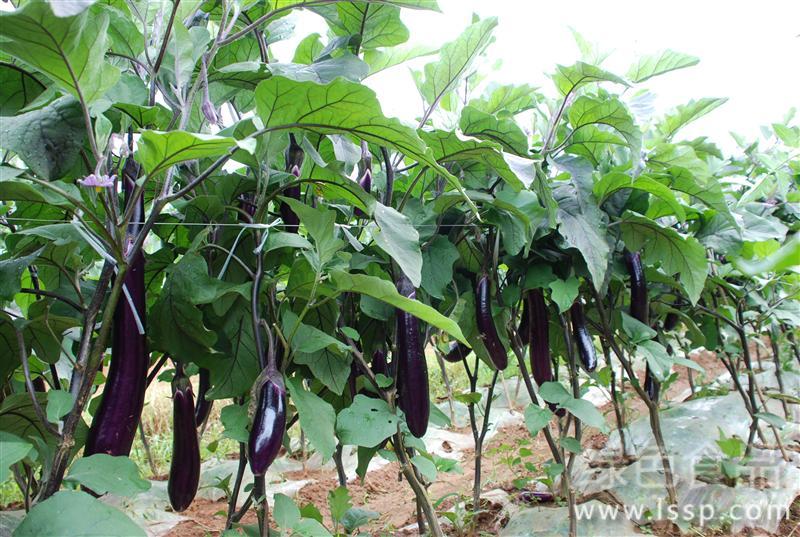
Eggplant
1. Varieties and seedling raising
Choose varieties with high yield, good quality, heat tolerance and strong disease resistance for high-yield cultivation, such as Hangqie, Hangfeng, Hangzhou Red Eggplant, Changhong No. 2, etc.
The seed treatment method is to first soak them in clean water for 15 minutes, then place them in hot water at about 55°C and soak for 20-30 minutes. During soaking, they need to be stirred continuously. Take them out and drain them, then soak the seeds in 500 times Tianyuan organic biochemical liquid fertilizer for 6 hours.
Sow from late April to early May, using 30 grams of seed per mu, requiring 10-15 sq m of seedbed. Water the seedbed thoroughly one day before sowing eggplant. On the second day, loosen the soil, level it, and sow evenly, then cover with 0.6-1 cm of sifted cinder ash, then cover with plastic film or sterilized straw, and then set up a small arch shed to keep warm and moist. When 60% of the seedlings emerge, remove the plastic film or straw. When the eggplant seedlings have 2 true leaves, remove weak seedlings, diseased seedlings and small seedlings, then prick out and transplant the seedlings once at a spacing of 10-12 cm.
2. Making beds and planting
Choose a plot with sufficient sunlight, deep soil, good water and fertilizer retention, convenient drainage and irrigation, and where solanaceous crops have not been planted for 3 years. After winter plowing, prepare and make beds. The bed width is 140 cm (including the ditch), the ditch depth is 35 cm, and the bed surface is made into a turtle-back shape. When eggplant seedlings are 30-35 days old and have 6-7 leaves, plant them. Plant 2 rows per bed, with a row spacing of 70 cm and a plant spacing of 45 cm, planting about 2,200 eggplant seedlings per mu.
3. Fertilizer and water management
After planting, water 2-3 times to help the eggplant seedlings recover, depending on their condition. Starting from the "door eggplant eyeing" stage, strengthen water management. Generally, watering and topdressing are combined. During the peak harvest period, provide sufficient water to the eggplant. Before making the beds, apply base fertilizer: 3,000 kg of decomposed barn manure or 250 kg of organic fertilizer, 50 kg of calcium magnesium phosphate fertilizer or 40 kg of sulfur-containing compound fertilizer, 0.5-1 kg of boron-zinc compound fertilizer, and 25 kg of potassium sulfate. For fields with relatively high acidity, add 50-100 kg of quicklime. Topdressing can be divided according to the various fruit-setting nodes into door eggplant fertilizer, opposite eggplant fertilizer, four-door bucket eggplant fertilizer, and late-stage fertilizer. For door eggplant fertilizer, apply 500-1,000 kg of 30% human excrement and urine combined with watering. For opposite eggplant fertilizer, when the opposite eggplant grows 8-10 cm, apply heavy topdressing 1-2 times, watering 3,500-5,000 kg of 30% decomposed human excrement and urine per mu, and add 5 kg of potassium sulfate. For four-door bucket eggplant fertilizer, apply another 30 kg of sulfur-containing compound fertilizer during the fruit-setting period of the four-door bucket eggplant. For late-stage fertilizer, use 500 times Tianyuan organic biochemical liquid fertilizer in the late fruiting period, spraying once every 10-14 days, until 20 days before the end of eggplant harvest, to prevent premature aging and increase the late-stage yield of eggplant.