How to prevent and control the high incidence of viral disease in broccoli in summer and autumn?
The main disease of broccoli is viral disease, which is widely distributed, common and severe, and occurs frequently in summer and autumn. Generally, 10% to 30‰ of plants are diseased, with little impact on yield. In severe cases, it can reach 60% to 80% or even higher, seriously affecting broccoli yield.
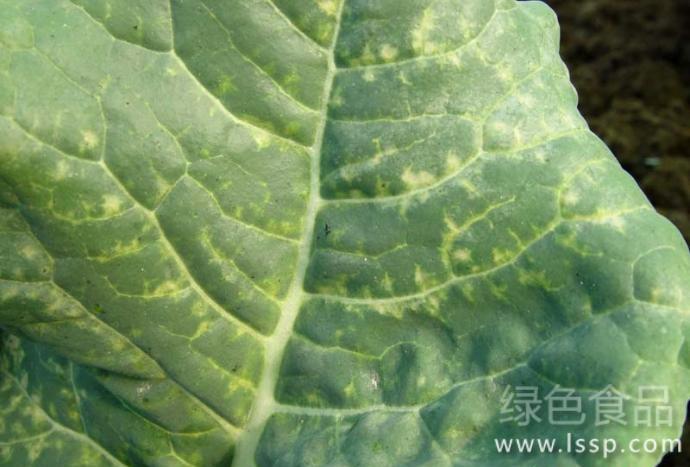
Broccoli viral disease
[Symptoms]
Viral disease occurs more severely at the seedling stage. In the early stage, nearly round small chlorotic spots appear on the leaves, then the leaf color becomes lighter, or green patches of alternating dark and light appear. Afterwards, the leaves shrink, twist and become deformed, and finally the whole plant dies. When broccoli plants are infected at the adult stage, in addition to uneven dark and light patches on young leaves, dark brown necrotic spots sometimes appear on the underside of old leaves, or are accompanied by vein necrosis. Finally, the plant becomes stunted and deformed, the petioles twist, and the proportion of inner and outer leaves is imbalanced. In mild cases, the curd becomes smaller; in severe cases, no head forms at all.
[Pathogen]
Viral disease is mainly caused by infection with Turnip mosaic virus, and is also caused by Cucumber mosaic virus (CMrv), Tobacco mosaic virus (CMV), Radish mosaic virus (TMV), or other viruses alone or in mixed infection with TuMV. The filamentous particles of Turnip mosaic virus measure 700 to 800 nanometers × 12 to 18 nanometers, with a thermal inactivation point of 55 to 60℃ for 10 minutes, a dilution endpoint of 1000 times, and a longevity in vitro of 48 to 72 hours. It is transmitted by aphids or contact rubbing, and in the field it is mainly transmitted by aphids.
[Disease development pattern]
Viral disease occurs frequently in warm regions, and the virus overwinters on Chinese cabbage, cabbage, radish or spinach. It is then transmitted to broccoli by green peach aphids, turnip aphids, cabbage aphids and others. Under high temperature and drought, and high soil temperature, the disease resistance of broccoli is significantly reduced, while aphids reproduce quickly and are highly active, causing viral disease to occur commonly. If management is extensive, the soil is dry, and there is a lack of water and fertilizer, the disease becomes severe.
[Control methods]
1. Select relatively disease-resistant broccoli varieties according to local conditions, such as Lulu, Luling, and Jiasida.
2. Use reasonable intercropping, relay cropping and crop rotation. For summer and autumn planting, keep a certain distance from other cruciferous vegetables, and promptly pull out severely diseased broccoli plants.
3. Adopt cultivation techniques using shade nets or non-woven fabric covers, apply more organic base fertilizer, and in hot and dry seasons pay attention to frequent light watering, control aphids, and control the occurrence and spread of viral disease.
4. In the early stage of viral disease, spray broccoli with 20% Virus A wettable powder at 500 times dilution, or 1.5% Zhibingling emulsion at 1000 times dilution, or spray compound fertilizer on the leaves to suppress the disease and enhance host disease resistance.