How to prevent and control late blight in celery causing low yields
Late blight severely affects the quality and yield of celery. The symptoms and prevention and control methods of celery late blight are as follows:
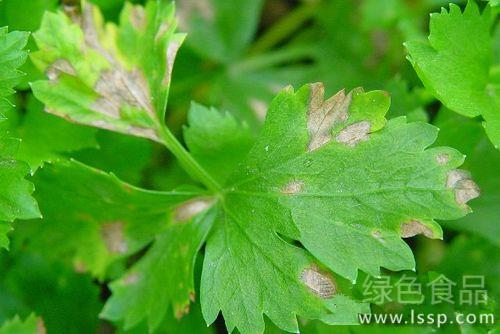
Celery late blight
I. Damage symptoms
Late blight mainly damages the leaves, petioles and stems of celery. The disease starts from the lower leaves of the celery plant, then spreads to the middle and upper leaves. When leaves are affected, small light brown oil-soaked spots appear first, gradually expanding into circular or irregular lesions with a diameter of 3-10 mm (mostly around 3 mm). The center of the lesion is brown, light brown or grayish white. The edge is dark reddish brown or yellowish brown, with a ring of yellow halo on the outer edge. In the later stage, many small black dots are scattered or clustered on the lesions. When petioles and stems are affected, the lesions are spindle-shaped or long oval, slightly sunken, brown, lighter inside, with densely packed small black dots on the surface. In severe cases, the leaves are densely covered with lesions, or the lesions merge into large patches, causing the celery leaves to dry up and die. There is also a large-spot type of lesion, generally circular, larger at 4-15 mm, with edges mostly dark green.
II. Prevention and control methods
1. Choose celery varieties with strong disease resistance.
2. Use seeds collected from disease-free celery plants or use old seeds from the previous year; if using new seeds from last year, celery seeds must be disinfected. The seeds can be soaked in warm water at 48°C for 30 minutes. This method slightly affects the seed germination rate, so the sowing rate should be increased by 10%.
3. Prepare the soil well and apply sufficient base fertilizer. 7 to 10 days after planting, start applying a small amount of fertilizer together with frequent watering; during the vigorous growth period, use plenty of water and fertilizer. When topdressing, pay attention to the combination of nitrogen, phosphorus and potassium; increase phosphorus fertilizer in the early stage and potassium fertilizer in the middle stage. Irrigation should be done with small amounts of water frequently, avoiding flood irrigation. Drain standing water from the field promptly after rain.
4. Harvest at the right time. In the early stage of the disease, remove diseased celery leaves, especially the lower leaves, and bury them deeply.
5. In severely affected fields, rotate crops for more than 2 years.
6. In the early stage of celery late blight, promptly spray with fungicides such as 75% chlorothalonil (Daconil) wettable powder at 600 times dilution for control.