Watermelon failing to set fruit affects yield, how to improve the fruit-setting rate
Watermelon failing to hold fruit during the fruit-setting period gives melon growers a headache, how to improve the watermelon fruit-setting rate. The editor's suggestions:
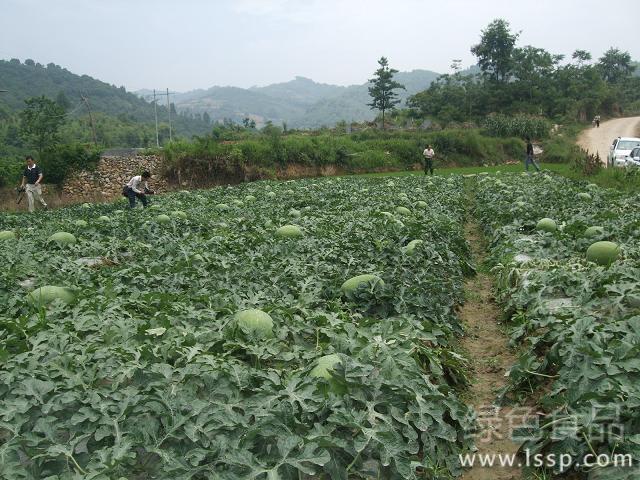
Watermelon field
1. Pruning and training vines:Use the three-vine pruning method. When the main vine of the watermelon reaches 150 cm and the secondary vines reach 30-50 cm, prune and train the vines, keeping the main vine and two robust secondary vines, and cutting off the excess secondary vines to form a three-vine system, so as to concentrate nutrients and encourage the watermelon to bloom and set fruit earlier. Especially when flowering, the secondary vines sprouting from the nodes before and after the female flower should be cut off in 2-3 rounds, which is beneficial for fruit setting.
2. Hand pollination:After the watermelon flowers, choose a suitable fruit-setting node position, and every day from 6 to 8 in the morning, use that day's male flower to gently touch the female flower that opened that day twice, for hand pollination. Right after touching the flower, cover the female flower with a paper bag prepared in advance to prevent rain from entering. After 3-5 days, once the fruit has set, remove the paper bag, or place it under the small watermelon. This can improve the fruit-setting rate of watermelons in rainy weather.
3. Pinching the growing tip or pinching the stem to keep the fruit:After the watermelon sets fruit, leave 10-15 leaves on the upper part of the main vine and pinch off the growing tip, to control the growth of the main vine, concentrate nutrients, and promote the watermelon's expansion. Or forcefully pinch the stem vine behind the young fruit until you hear a "crack", and the young watermelon will set in nine cases out of ten.
4. Reasonable fertilization, regulating growth:Control the amount of nitrogen fertilizer used, increase phosphorus and potassium fertilizer, reduce the number of waterings, and use methods such as strengthening pruning and deeply burying the vines to control vegetative growth. Before flowering and after fruiting, this can improve the watermelon fruit-setting rate, promote growth, and improve watermelon quality; apply fruit-strengthening fertilizer appropriately. When the watermelon grows to the size of a fist, apply 10-15 kg of compound fertilizer as fruit-strengthening fertilizer per mu, plus 50-75 kg of rapeseed cake, to supplement nutrients and promote watermelon growth and expansion.
Watermelon
5. Timely prevention and control of pests and diseases:Continuous rainy days are a period of high incidence of watermelon anthracnose, fusarium wilt and other diseases, which need timely prevention and control. Methods include: ① Promptly remove diseased leaves and cut off diseased branches. ② Open drainage ditches around the melon field to lower the groundwater level. ③ Every 7-10 days, or seizing a sunny day, spray the leaves with 70% chlorothalonil 1500x solution to prevent and control watermelon anthracnose and other diseases. To prevent and control watermelon fusarium wilt, after pulling out diseased plants, drench the roots with a copper preparation. ④ You can use 25% "Yakexing" (aphid killer) 1000x solution spray to control aphids.
6. The watermelon fruit-setting rate can also be improved by measures such as spraying vinegar, spraying cytokinin or gibberellin:
Spraying vinegar.When the watermelon seedlings have grown 1-2 true leaves, spray once each before flowering and after flowering with 500x vinegar solution. The watermelon ripening period is advanced by 5-6 days, and the yield is increased by 30%-35%.
Spraying cytokinin.Spraying watermelon at the flowering stage with cytokinin solution can increase the watermelon fruit-setting rate by about 20%, increase the sugar content by 1.5-2 degrees, and increase yield by 27%-30%. Method of use: in late May or early June, when the watermelon vines already have 5-8 nodes, carry out the first spray; after the first spray, the flower buds are concentrated, carry out the second spray; spray once every 5 days, generally 4 sprays. For the concentration of cytokinin used, each time dissolve 50 g of cytokinin in 25 kg of clean water. For the 1st and 2nd sprays, use 25 kg of cytokinin aqueous solution per mu each time; for the 3rd and 4th sprays, use 50 kg.
Spraying low-concentration gibberellin.Spray young watermelons the size of a walnut with 20-30 ppm gibberellin. Method: take 1 g of gibberellin, dissolve it with 50 g of alcohol, then add 30 kg of cold boiled water to make a 25 ppm gibberellin aqueous solution, spray the melons with a small sprayer, or apply it with a writing brush to moisten them, and after 3-5 days the young watermelons will show obvious growth.