Cucumber downy mildew is one of the cucumber diseases in summer, how to prevent and control it
Downy mildew, commonly known as "running horse dry" and "black hair", is one of the main cucumber diseases in summer. It comes on fiercely, spreads quickly and causes severe damage, and can kill almost all the leaves of a cucumber plant within one or two weeks, seriously affecting cucumber yield. So how do you prevent and control cucumber downy mildew?
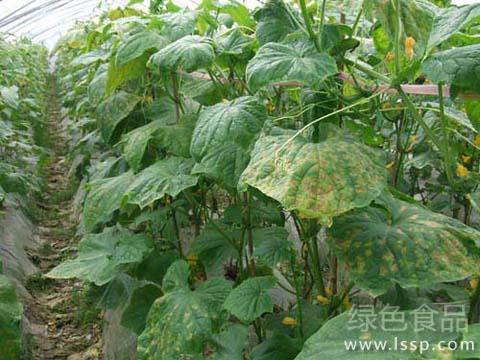
Cucumber downy mildew
Symptom characteristics
The disease starts on the lower leaves of the cucumber plant first. Many pale green water-soaked small spots appear on the leaf edges, then develop into large yellow-green to yellow spots; restricted by the leaf veins, the lesions are polygonal. In the morning, or when a water film forms on the cucumber leaf surface, the lesions appear dark green and water-soaked. Under humid conditions, irregular purplish-brown or dark brown lesions form on the underside of cucumber leaves infected with downy mildew, with downy mildew growth on the surface. In severe cases the lesions merge, the leaves turn dark brown and their edges curl upward, and the cucumber leaves wither and die from the bottom up.
Disease development pattern
The disease is an airborne fungal disease caused by infection with Pseudoperonospora cubensis. It can occur as long as the temperature is 16-20°C and the relative humidity is above 85%. The optimum temperature for downy mildew development is 20-26°C, and dew or a water film on the cucumber leaf surface is a necessary condition for infection by downy mildew. During infection, the spores produced by the sporangia germinate into germ tubes, or the sporangia germinate germ tubes directly, and penetrate directly through the cucumber leaf epidermis, causing the disease to become epidemic. Whether the climate is cold or hot, humid air and large day-night temperature differences will all cause the occurrence and spread of cucumber downy mildew.
Prevention and control methods
1. Agricultural control.Choose disease-resistant varieties, such as Jinza No. 1, No. 2, No. 3, No. 4, Xiafeng No. 1, Jicai No. 2, Zhongnong 1101, etc. The key to cucumber cultivation and management lies in water control: water little but often, and pay attention to ventilation and dehumidification. Applying sufficient base fertilizer and adding phosphorus and potassium fertilizer helps strengthen the disease resistance of cucumber plants. Reasonably arrange the cucumber planting density, promptly remove old leaves and diseased leaves, so that the field is ventilated and lets light through and the field humidity is reduced, which can lessen the occurrence and spread of downy mildew. You can use the high-temperature greenhouse closing method: close the greenhouse at noon for 2 hours so that the temperature in the upper part of the cucumber plants reaches 44-46°C, which can kill part of the downy mildew fungus in the greenhouse; do this once every 7 days.
2. Chemical control.Focus on prevention; before downy mildew occurs, you should spray to prevent it. When the disease appears, spray immediately for control. Commonly used agents include 58% metalaxyl · mancozeb wettable powder at 500 times dilution, 64% sandofan wettable powder at 500 times dilution, 72.2% propamocarb aqueous solution at 800 times dilution, 80% fosetyl-aluminium (phosethyl-Al, efosite-Al) at 600 times dilution, 70% fosetyl-aluminium · mancozeb wettable powder at 500 times dilution, 72% cymoxanil · mancozeb wettable powder at 700 times dilution, and DuPont Curzate at 800 times dilution, spraying once every 7-8 days, with the number of sprays determined according to the severity of the cucumber downy mildew. To avoid the cucumber developing resistance to the chemicals, alternate the use of the above pesticides.