Cabbage head splitting affects appearance; how do you prevent and control cabbage splitting?
During cultivation, cabbage often develops split heads, which affects its appearance. In addition, split-head cabbage is prone to infection by pathogens and rot during storage and transport. The most common type is splitting at the top of the cabbage, and sometimes the sides split as well. Most splits are a single line, while a small number are crossed splits running lengthwise and crosswise. The degree of splitting varies: in mild cases only the outer few layers of leaves split, while in severe cases the split can reach as deep as the compressed stem.
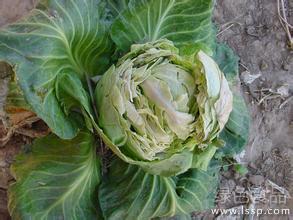
Cabbage head splitting
Cause: The main cause of cabbage splitting is excessive water uptake by the cells, causing them to burst. The water content of cabbage tissues is over 90%. Cabbage has a shallow root system and large leaves with high transpiration, and grows best when soil moisture is 70%-80%. If soil moisture is insufficient, the cabbage head is small and not firm. Therefore, it should be watered frequently to keep the soil moist. However, after the cabbage forms its head, the head tissue is crisp and tender and the cells have little flexibility, so if there is too much soil moisture, the cabbage is prone to splitting.
Prevention and control methods: When planting cabbage, choose fields with flat terrain, convenient drainage and irrigation, and fertile soil. Choose cabbage varieties that are not prone to splitting; generally, pointed-head cabbage varieties split less, while round-headed and flat-headed types split more. Strengthen water and fertilizer management, apply sufficient base fertilizer, and apply more organic fertilizer to enhance the soil's water- and fertilizer-holding capacity, so as to buffer the effects of excessive, insufficient, and sudden changes in soil moisture on the cabbage plants. Cabbage has a relatively high water requirement and needs to be watered multiple times throughout the growing period. Watering should be moderate, based on keeping the soil moist, and avoid flood irrigation; there should be no standing water on the ground after watering. Drain standing water from the field promptly after rain, especially when headed cabbage encounters heavy rain and water accumulates on the ground, which can easily cause a large number of split heads. Harvest at the right time, as overmature cabbage is also prone to splitting.