How to prevent and control rust disease in green beans when it affects yield
Rust disease is a major disease harming green beans. It occurs commonly and can massively destroy the nutrient area of the bean leaves, causing leaf damage and water loss in the plants, and seriously affecting yield.
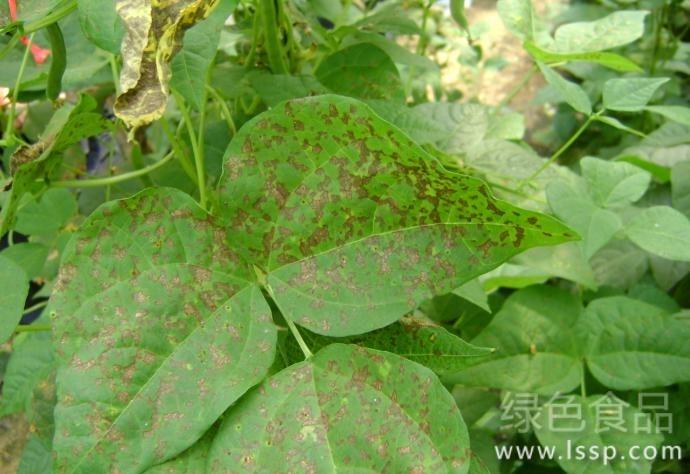
Green bean rust disease
1. Pathogen. This disease is caused by infection by fungi of the genus Uromyces in the Basidiomycota subphylum. The pathogen overwinters on seeds or diseased plant residues and can survive for 2 to 3 years; the following year, under suitable temperature and moisture conditions, it germinates, produces mycelium and microspores that invade the host, then produces urediniospores that spread with wind and rain and cause further infection.
2. Symptom identification. Rust-colored raised lesions appear on the surface of diseased green bean leaves. When dense, the leaf surface is destroyed, accelerating water loss and causing the leaves to turn yellow, shrivel and drop; when the veins are affected, the leaves become deformed; the tip of the diseased pod becomes smaller and curved; in severe cases it also harms the petioles, stems and pods.
3. Conditions for disease occurrence. High temperature and high humidity, with dew or rainwater on the leaf surface, make the disease prone to occur; weak disease resistance of the plants, low-lying bean fields with poor drainage, overly dense planting, poor ventilation and light penetration; a microclimate of excessive field humidity caused by trellising, etc., all favor the occurrence of the disease.
4. Control techniques.
(1) After harvest, clear away dead branches and fallen leaves from the field and burn them in a centralized manner.
(2) Practice crop rotation with non-legume vegetables such as leafy greens and cucurbits.
(3) Select excellent disease-resistant green bean varieties.
(4) Strengthen field management, apply sufficient fertilizer and water, and do not apply excessive nitrogen fertilizer.
(5) Promptly remove diseased leaves and old yellow leaves, and carry them out of the bean field to be burned or buried.
(6) Spray promptly at the early stage of disease onset. You may choose 50% carbendazim wettable powder at 800 times dilution; or 65% zineb wettable powder at 500 times dilution; or 50% carboxin wettable powder at 1000 times dilution, spraying green beans once every 7 to 10 days, with 2 to 3 consecutive applications for control.