How is the herbicide pyroxsulam used in wheat fields?
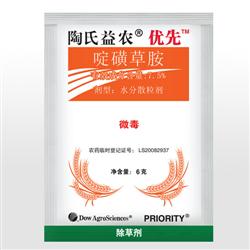
How is the herbicide pyroxsulam used in wheat fields? Please give an introduction. Pyroxsulam 7.5% water-dispersible granules, a priority for weed control in wheat fields, is a sulfonamide herbicide launched in the winter of 2009 by Dow AgroSciences of the United States for controlling grass weeds in wheat fields while also controlling broadleaf weeds. In recent years, through a large number of trials and...
How is the herbicide pyroxsulam used in wheat fields? Please give an introduction.
Pyroxsulam 7.5% water-dispersible granules, a priority for weed control in wheat fields, is a sulfonamide herbicide launched in the winter of 2009 by Dow AgroSciences of the United States for controlling grass weeds in wheat fields while also controlling broadleaf weeds. In recent years, through a large number of trials and follow-up surveys of farmers' use, the author found that pyroxsulam has good control effects on grass weeds such as bromegrass, shortawn foxtail, Japanese shortawn foxtail (including resistant shortawn foxtail and resistant Japanese shortawn foxtail), and hardgrass, while also having good control effects on broadleaf weeds such as speedwell and wild geranium.
Due to special weather conditions last year, pyroxsulam caused slight phytotoxic reactions on some sensitive wheat varieties (such as some varieties of the Yangmai series). In fields where more than 12.5 grams of pyroxsulam 7.5% water-dispersible granules per mu (the recommended maximum dosage) was used or where spraying was repeated (especially in low-lying waterlogged areas), 15 days after application under low temperatures, some wheat leaf tips turned yellow and then white, and in severe cases the seedlings showed stunted growth. As temperatures rise and new leaves continue to emerge, the wheat seedlings can quickly resume normal growth, and the final yield is not greatly affected. Therefore, after using pyroxsulam, if wheat shows phytotoxic reactions, as long as the symptoms are not too severe, no special remedial measures are needed. For fields with particularly severe symptoms, brassinolide plant growth regulator can be sprayed to promote recovery of the wheat seedlings.
Click to get more herbicide application techniques
Click to get more pesticide application techniques