How should 25% Cabrio fungicide be used correctly?
How should 25% Cabrio fungicide be used? Please give an introduction. With the development of profitable agriculture, economic crops, mainly fruits and vegetables, have been expanded on a large scale. This has been followed by the occurrence of diseases in various economic crops, seriously affecting the high quality and high yield of agricultural products and farmers' increased production and income. Especially for grapes, in our province throughout the entire growth period...
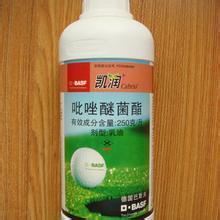
How should 25% Cabrio fungicide be used? Please give an introduction.
With the development of profitable agriculture, economic crops, mainly fruits and vegetables, have been expanded on a large scale. This has been followed by the occurrence of diseases in various economic crops, seriously affecting the high quality and high yield of agricultural products and farmers' increased production and income. Especially for grapes, in our province throughout the entire growth period the climate makes them highly susceptible to multiple diseases, and once these spread widely, it is very difficult to find effective pesticides to control the spread. 25% Cabrio emulsifiable concentrate can effectively prevent, control and treat diseases of many crops, and after large-scale trial demonstrations on many crops, it has become increasingly popular. The relevant application techniques are introduced below:
I. Product characteristics. 25% Cabrio emulsifiable concentrate is a pyraclostrobin-type fungicide, developed and produced by the German company BASF, and has obtained patent protection in China. It is a specific-effect pesticide that can prevent and treat powdery mildew, downy mildew, black spot, leaf spot, blight and other diseases of many melons, fruits and vegetables, and has rapid and lasting action, strong efficacy and reliability. Used in vineyards of different varieties and on many crops at home and abroad, it is exceptionally outstanding in controlling various major fungal diseases; for the most commonly occurring diseases such as downy mildew and powdery mildew on leaves and fruits, it can effectively prevent, control and treat them.
II. Application techniques. This product has been registered abroad on more than 60 crops for controlling fungal diseases, and domestically it has been promoted and applied by agricultural departments to cucumbers, bananas, grapes, strawberries, vegetables and many other crops, with very significant preventive and therapeutic effects. 1. For grape black pox, powdery mildew and anthracnose, which are most likely to occur and spread under high-temperature and high-humidity climate conditions, a method combining prevention and treatment should be adopted, that is, spray once before the disease occurs, and after an interval of 7-10 days, depending on disease development and climate conditions, spray 2-3 more times, which can effectively prevent the occurrence of many grape diseases. The concentration used is 1500-3000 times, that is, add 10-20 milliliters of 25% Cabrio emulsifiable concentrate to each backpack manual sprayer of water, and spray finely and evenly. 2. For various blights, powdery mildew and early and late blight on cucumber, strawberry, tomato and leafy vegetables, prevent once before occurrence, and afterward, depending on high temperature and humid weather favorable to disease, spray 2-3 more times; the concentration used is 2000 times, that is, add 8-10 milliliters of 25% Cabrio emulsifiable concentrate to each backpack manual sprayer of water and spray finely. 3. For other crops, such as tea, asparagus and flowers with various fungal diseases, the above concentrations can also be used as a reference for control.
III. Precautions. 1. The pesticide-to-water ratio should be based on the concentration indicated on the pesticide packaging label; do not arbitrarily increase the dilution strength. 2. Be sure to use a knapsack power mist sprayer or manual sprayer for fine spraying; the more sufficient the water, the better the efficacy, and applying the pesticide in the morning and evening is recommended; in summer high temperatures, do not apply at noon. 3. Spraying must be careful and thorough; the leaves, fruits and main stems of the crops must all be sprayed to prevent missed spraying from affecting efficacy. 4. When spraying crops not specified on the label, especially at the true leaf stage, first conduct a small-scale test, and only after obtaining results promote and apply it over a large area.
Click to get more fungicide application techniques
Click to get more pesticide application techniques