Cowpea is prone to mosaic disease in summer; what are the control methods?
Mosaic disease is one of the most common diseases on cowpea, occurring mostly in the high-temperature and drought-prone seasons of summer and autumn, and in severe cases it can greatly reduce cowpea yield and lower quality.
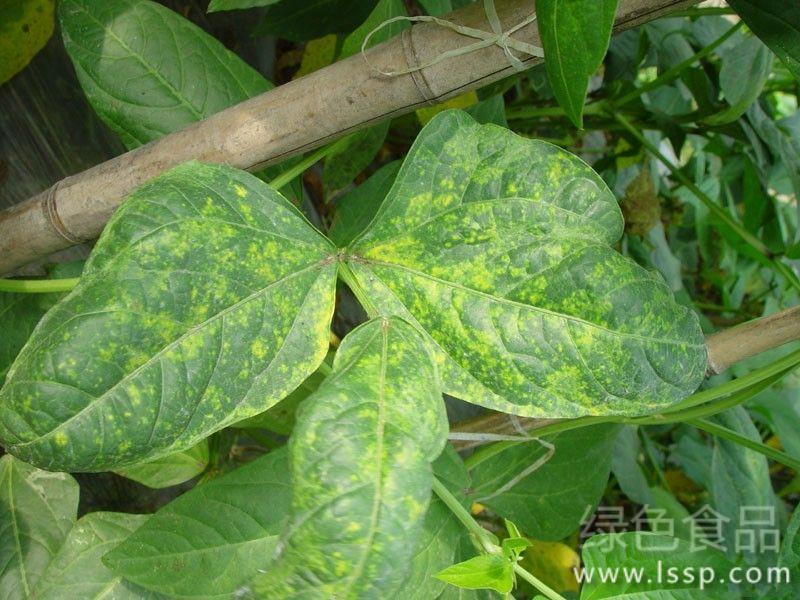
Cowpea mosaic disease
I. Disease symptoms:
Mosaic disease damages the entire cowpea plant. Symptoms first appear on the upper leaves, showing a mosaic or mottling of dark green and light green, and in severe cases the cowpea leaves become crinkled and deformed. Mosaic disease causes cowpea plants to grow weak, with shortened internodes and whole-plant dwarfing. When diseased plants flower, the floral organs are deformed, flowers are sparse, pod set is low, pods are rat-tail shaped, seeds are not plump, and brown necrotic streaks may also appear.
II. Pathogen:
Cowpea mosaic disease is caused by infection by several viruses, mainly 3 types: 1. Cucumber mosaic virus. The virus is transmitted through rubbing contact, but is mainly spread by various aphids such as cabbage aphid, green peach aphid, and cotton aphid. Seeds are not virus-carrying. 2. Cowpea aphid-transmitted mosaic virus. It is mainly transmitted by green peach aphid, cotton aphid, and bean aphid; sap rubbing contact and seeds can also transmit the virus; seeds also have a virus-carrying rate of about 8-10%. Besides infecting cowpea, it can also infect mung bean, lima bean, and chenopodium amaranticolor, quinoa chenopodium, etc. 3. Cowpea mosaic virus. Diseased sap is transmitted by rubbing contact, and cotton aphid and green peach aphid can also transmit the virus. Generally cowpea seeds do not carry the virus, but seeds of asparagus bean have a certain virus-carrying rate.
III. Occurrence pattern and disease conditions of cowpea mosaic disease:
Virus source: apart from a few virus-carrying seeds, infected host plants in the field and certain weed hosts are the main sources of virus. The disease is mainly spread in the field through virus-transmitting winged aphids and through sap contact during farm operations, completing secondary infection. High temperature, dry weather, extensive cultivation management, and lack of fertilizer and water are all factors that induce cowpea mosaic disease.
IV. Control methods:
1. Select and keep seeds from plump pods borne by disease-free cowpea plants.
2. Strengthen disease-control cultivation management for cowpea: clear wild weeds at the field edges, apply more high-quality organic fertilizer, and topdress in time. In dry seasons, water frequently to prevent soil moisture deficiency, so that plants grow vigorously and resistance and tolerance to disease are improved.
3. Control aphids early: to prevent cowpea aphids from spreading the virus, starting from the seedling stage, spray with 40% dimethoate emulsifiable concentrate at 1000-1500 times dilution, or 20% fenvalerate emulsifiable concentrate at 3000 times dilution.
4. Starting from the seedling stage, some nutritional resistance enhancers can be sprayed, such as Baifunong at 800-1000 times dilution, 20% Virus A wettable powder at 500 times dilution, Junduqing at 300 times dilution, Yemianbao, etc.