Season-Free Soilless Cultivation: How to Grow Yellow Chives Without Soil
Yellow chives are a vegetable much loved by people. Yellow chives are grown soillessly in boxes with controlled temperature; the technique is simple, is not limited by season, allows production all year round, and gives good returns.
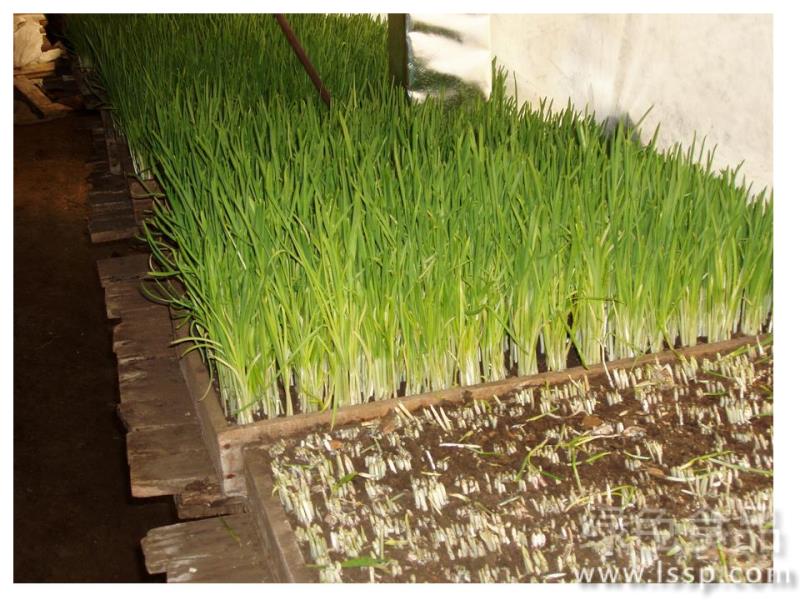
Yellow chives
1. Variety selection. Choose early- and mid-maturing, high-yielding, high-quality yellow chive varieties.
2. Site selection. Choose a building with good air circulation and good shading for the production site.
3. Wooden box preparation. Use lightweight wooden boards to make yellow chive seedling boxes measuring 60 cm × 25 cm × 30 cm (length × width × height); the bottom of the box must be flat, with both drainage holes and ventilation holes.
4. Seed soaking. Remove garlic cloves whose roots have turned brown or whose flesh has turned yellow, as well as diseased and damaged garlic heads; soak the garlic seed in clean water for 12 hours to absorb enough moisture.
5. Sowing. Before sowing, first wash the yellow chive seedling boxes clean, then lay a layer of newspaper on the bottom of each box, and sprinkle a thin layer of clean river sand on top as the growing substrate. Arrange the soaked garlic heads tightly on the sand surface in the box, fill the gaps with garlic cloves, then spray with water; generally about 15 kg of dry garlic heads is sown per square meter of wooden box. After sowing, cover the box surface with straw curtains to keep the cultivation room dark.
6. Management. Keep the temperature in the yellow chive cultivation room at 25—27℃, spray water 2—3 times a day, and ventilate frequently. After the yellow chives emerge, lower the temperature to 18-22℃. In the 4—5 days before harvest, keep the room temperature at a suitable 10-15℃.
7. Harvesting. Under normal cultivation conditions, yellow chives take about 20-25 days from sowing to harvest; they can be harvested when the seedlings have grown to 30-40 cm. After the first harvest, promptly spray water and manage moisture and temperature, and generally they can be harvested again after 15-20 days.