Rice bacterial leaf blight affects yield, how to prevent and control it
Rice bacterial leaf blight is a disease caused by infection with Xanthomonas oryzae pv. oryzae.
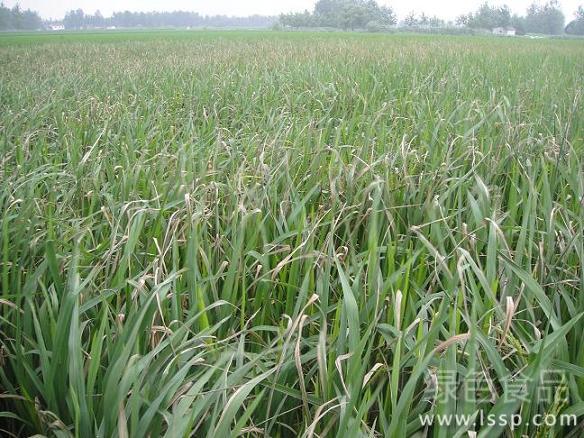
Rice bacterial leaf blight
[Diagnosis] The main symptoms are: ① Common type: generally appears at the late tillering stage; yellow-green or dark green spots first appear at the leaf tip or leaf margin of the rice, later developing into streak lesions; the diseased part is grayish-white, and the boundary line between the diseased part and the healthy part is obvious and wavy. When humidity is high, "fish-egg"-shaped bacterial ooze containing many bacterial leaf blight bacteria can be seen with the naked eye on the diseased part; the color of the lesions varies with different rice types. ② Acute type: occurs when environmental conditions are suitable and the rice variety is susceptible; the lesions are dark green, spread rapidly, and look like scalding by boiling water, with bacterial ooze on the diseased part. ③ Wilt type: mostly occurs at the late seedling stage and the jointing stage; the young leaf rolls up green and appears as green wilt.
[Disease development pattern] Xanthomonas oryzae pv. oryzae mainly overwinters on diseased rice straw, rice stubble, ratoon rice, rice seed and some weeds, and in the second year is mainly spread by running water, wind and rain, infecting rice through water pores or wounds. High temperature, high humidity, and frequent typhoons and rainstorms are conditions for the epidemic of the disease. Continuous irrigation by running water through the rice field, excessive application of nitrogen fertilizer, and acidic soil are conducive to the occurrence of the disease.
[Prevention and control] The prevention and control of rice bacterial leaf blight should be based on controlling the source of bacteria as the prerequisite, planting disease-resistant rice varieties as the foundation, seedling control as the key, vigorously managing fertilizer and water, and supplementing with chemical control.
(1) Agricultural measures: cultivate disease-free strong seedlings, strengthen fertilizer and water management, and by no means use deep irrigation, continuous irrigation through the field, or flooding irrigation.
(2) Use disease-resistant varieties.
(3) Prevent diseased straw from entering the field, and carry out seed treatment: soak seeds in 2000-fold dilution of 80% 402 antibacterial agent for 48-72 hours, or soak seeds in 500-600-fold dilution of 20% Yeqingshuang wettable powder for 24-48 hours.
(4) Chemical control: the key is to carry out control in rice seedling fields and in the early stage before disease onset; in seedling fields, it is done at the three-leaf-one-heart stage of rice seedlings, and in the main field, it is done when scattered diseased rice plants (disease centers) appear. The chemicals include, per mu, 125 g of 20% Yeqingshuang wettable powder, or 300 g of 25% Yekuling wettable powder, or 30 mL of 12% Shidaoling suspension concentrate, or 70 g of 10% chloramphenicol wettable powder, etc., sprayed with 75 kg of water; in the main field, spray continuously 2-3 times at intervals of 7 days in the initial disease stage.