Key points for summer management of cherry tomatoes in greenhouses to ensure off-season supply
Cherry tomatoes are both ornamental and edible, with a unique flavor and rich nutrition. Cherry tomatoes are generally cultivated in spring and autumn. Summer's high temperatures and heavy rain bring more pests and diseases, which easily cause low yields or even total crop failure, so there is a relatively large gap in demand for cherry tomatoes in summer and autumn. In summer there are often idle plastic greenhouses that can be used to shade light and block rain so cherry tomatoes can safely pass through the summer, meeting off-season demand. The specific cultivation techniques for overwintering cherry tomatoes are as follows:
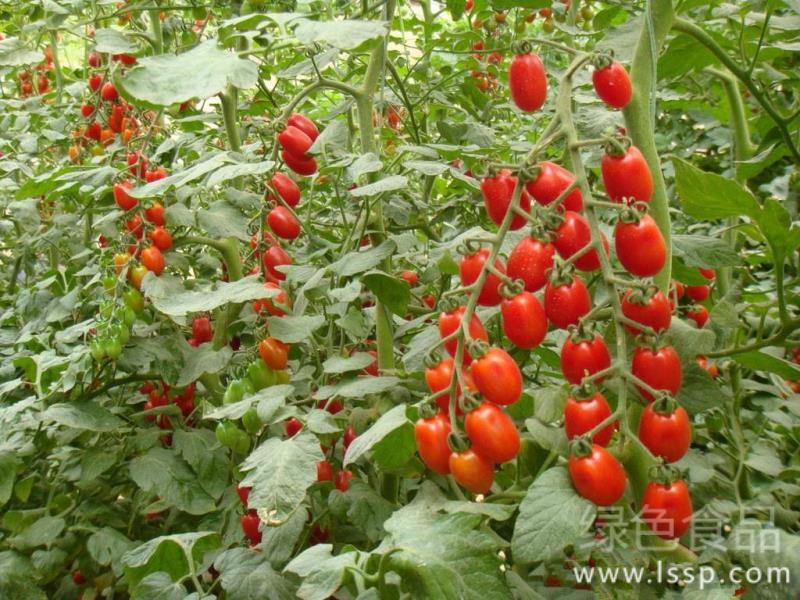
Cherry tomato
I. Variety selection
Choose the "Shengnyu" and "Cherry Red" varieties, which have strong fruiting ability and strong disease resistance. The "Shengnyu" variety's cherry tomatoes are date-shaped, while "Cherry Red" is round.
II. Sowing
1. Seed treatment before sowing: The suitable sowing period for overwintering cherry tomatoes is June 12-16. First soak the seeds in 55°C warm water for 5 minutes, then soak in 30°C water for 3-4 hours, then soak in a 10% trisodium phosphate solution for 20 minutes, then remove and rinse with clean water 3-4 times, remove the mucus, and mix in an equal amount of fine sand.
2. Sowing: Use the direct sowing method in the greenhouse. After harvesting the previous crop, apply 5000 kg of decomposed organic fertilizer, 20 kg of nitrogen-phosphorus-potassium compound fertilizer, and 20 kg of superphosphate. After preparing the land, make beds 150 cm wide, open furrows 2-3 cm deep, with 3 furrows per bed. Use the hill-drop sowing method, with 4-5 seeds per hill, hill spacing 20 cm. After sowing, cover with soil, then water. Open the bottom vents and waist vents of the greenhouse. When wind and rain occur, close the vents to prevent rain erosion and strong winds from lifting the film. Normally the seedlings emerge completely in 3 to 4 days.
III. Seedling management
1. Watering: If the soil is dry, water lightly in the morning or evening, keeping the soil alternately dry and moist.
2. Thinning and weeding: When the cherry tomato seedlings grow 2 true leaves, thin them in time, leaving 2 plants per hill, with hill spacing 20 cm, and weed in time.
Mini tomato
IV. Management during the flowering and fruiting period
1. Planting and pruning: Plant at the early flowering stage, leaving 1 plant per hill, with 4000-4500 cherry tomato plants per mu. Cherry tomato plants are tall and have poor upright growth. When they grow to 50 cm, trellises should be set up to prevent lodging. Cherry tomatoes have strong lateral branch growth. For two-stem pruning, select and keep 2 strong branches, promptly remove other lateral branches, and generally do not pinch the growing tip. Promptly remove the yellowed old leaves at the bottom to reduce nutrient consumption and increase light penetration and air circulation.
2. Flower thinning and fruit retention: Dip flowers with 25 ppm of fruit-setting hormone or 15 ppm of 2,4-D. Each cluster of cherry tomatoes bears many flowers and fruits. Select and keep 20-30 well-set fruits, remove other flowers and fruits, and thin out deformed fruits and rotten fruits.
3. Fertilizer and water management: During the flowering period, open furrows and apply topdressing, applying 150 kg of decomposed hemp seed cake per mu. After the first fruit cluster sets, apply 10 kg of diammonium phosphate, 25 kg of potassium sulfate, and 20 kg of urea per mu with irrigation; after the second fruit cluster sets, apply 20 kg of potassium sulfate and 10 kg of urea per mu with irrigation.
V. Harvesting
Harvest when fully ripe. When harvesting, keep the calyx and a section of the fruit stalk of the cherry tomatoes, and bring them to market in time.
VI. Pest and disease control
1. Aphids: On the basis of hanging silver-gray film at the greenhouse vents to repel aphids, omethoate can be used to control aphids.
2. Late blight: Control with 65% zineb 500-fold solution.
3. Gray mold: Control with 50% iprodione wettable powder 1500-fold solution.
4. Cotton bollworm: After moths are found, promptly use fenvalerate and phoxim for control, focusing on the tender tips and fruit clusters of cherry tomatoes, and spray evenly and thoroughly.
5. Viral disease: Disinfect with 1% mercuric chloride solution or 1% trisodium phosphate.