Grape berry cracking affects yield and appearance quality, how should it be prevented and controlled?
The occurrence of berry cracking in grapes severely affects grape yield and fruit quality, reducing growers' economic income.
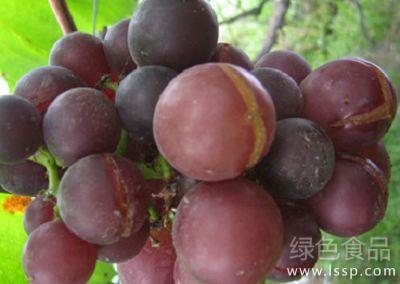
Grape berry cracking
1. Main causes of berry cracking
1.1 Pest damage
Pests damage not only the leaves but also the young grape berries. On damaged berries, the skin at the pest spots becomes suberized and cannot grow in step with the flesh cells during the swelling stage. As the flesh cells expand, cracks form at the edges of the pest spots (that is, berry cracking).
1.2 Abuse of swelling agents
In recent years, as large-berried grapes have become favored by distributors and consumers, many growers have freely abused swelling agents in pursuit of higher economic returns. According to surveys, the occurrence of berry cracking is clearly positively correlated with the concentration and method of swelling agent use and with fruit size.
1.3 Improper irrigation
From the early ripening stage to the ripening stage of grapes, growers irrigate heavily to increase yield. Because the water content of the orchard soil fluctuates sharply, the water-absorbing capacity of the flesh cells is markedly higher than that of the skin cells, and the flesh cells swell from water uptake faster than the skin cells, causing berry cracking.
1.4 Insufficient calcium nutrition
The element calcium participates in the formation of cell walls in the form of calcium pectate. It can reduce the hydration of protoplasm, regulate the vitality of protoplasm, and make the water saturation, viscosity, elasticity and permeability of cells all suitable for normal plant growth; it is also an activator of some enzymes and coenzymes. The calcium content in grapes exceeds that of phosphorus, but because calcium cannot be reused within the plant, the calcium content in the fruit is markedly lower than in the leaves. Before grapes ripen, many growers apply large amounts of chemical fertilizers to swell the fruit, especially nitrogen and potassium fertilizers, while applying too little or no silicon-calcium fertilizer, or never spraying calcium fertilizer on the leaves, causing the fruit to stay green, and the skin cells and flesh cells to lack toughness and elasticity, resulting in berry cracking.
Grape berry cracking
2. Effective measures to prevent berry cracking
2.1 Use growth regulators with caution
Use cytokinin (swelling agent) type growth regulators with caution during the young berry stage. The original physiological characteristics of the variety should be maintained.
2.2 Reasonable crop load
On a small trellis, keep 6 to 8 fruit clusters on each main cane. At the same time, adjust the crop load in combination with other summer pruning measures. Control the yield per 666.7 sq m to 1500 kg to 2000 kg. Because the yield is reasonable, normal coloring can be achieved and quality improved without artificial spraying of coloring agents.
2.3 Timely control of green plant bugs and grape black pox
To control green plant bugs, at the three key periods - when the new shoots have two or three leaves, at the inflorescence separation stage, and 3 days after flowering - use 5% beta-cypermethrin aqueous emulsion at 1000 times + 5% acetamiprid microemulsion at 1000 times, or 40% chlorpyrifos emulsifiable concentrate at 1500 times, or 20% carbosulfan emulsifiable concentrate at 2000 times, or 3.2% emamectin benzoate-cypermethrin at 1000 times + 10% imidacloprid wettable powder at 2000 times, used alternately, spraying the whole tree.
2.4 Implement growing grass or mulching
Growing grass in the vineyard or mulching the ground can reduce severe fluctuations in soil water content and prevent the soil from becoming too dry or too waterlogged. Light irrigation in small amounts and multiple times is advisable. According to weather conditions, if the temperature is high, appropriately irrigate lightly or spray water in the orchard to regulate the temperature of the trees and the orchard.
2.5 Increase application of organic fertilizer and silicon and calcium fertilizers
For trees in full fruit period, generally apply 10 kg of organic fertilizer per tree, 0.15 to 0.25 kg of phosphorus and potassium fertilizers, and 0.25 to 0.5 kg of silicon-calcium fertilizer.
Bag the grapes according to the yield situation to reduce water absorption on the fruit surface.