Many Causes of Tomato Leaf Curling, Analysis of Targeted Control Methods
When growing tomatoes, whether in greenhouses or open fields, under high temperature and drought, leaf curling with different symptoms caused by different reasons is prone to occur. The main causes and symptoms of tomato leaf curling are as follows:
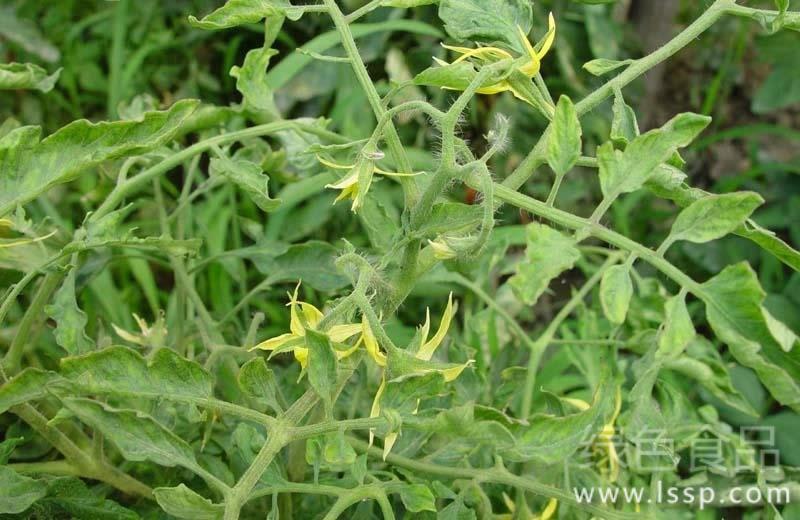
Tomato leaf curling
I. Virus disease damage:Tomato leaves curl and grow in clusters; in severe cases, only leaf veins remain with no leaf flesh. The virus spreads through aphids, whiteflies and sap contact, and occurs frequently under high temperature and drought. Control measures: select disease-resistant tomato varieties; implement crop rotation to reduce the initial infection source; for leaf curling caused by virus disease, spray 1000 times diluted potassium permanganate solution at the early stage; to kill the virus-transmitting aphids and whiteflies, use 10% Yibianjing 1500-2000 times diluted solution.
II. Physiological leaf curling:Before and after tomato harvest, the leaves of the first fruit truss curl slightly, or the leaves of the whole tomato plant curl into a tube shape and become brittle, which is caused by high temperature and drought leading to closure of tomato stomata. Control measures: water and fertilize timely after tomato fruit set, and cover with a shade net, covering during the day on sunny days, removing at night, and not covering on cloudy days.
III. Nutrient deficiency:The underside of tomato leaves is purplish red with small brown spots, the lower leaves curl upward, the curled leaves turn yellow, and the leaf tips die and turn dark brown. It can be solved by applying phosphate fertilizer to the soil or spraying 0.3% potassium dihydrogen phosphate on the leaves. Magnesium deficiency shows as follows: during the swelling stage of the first truss of tomatoes, the lower gray leaves lose green, yellowing appears between the veins, then spreads upward, forming yellow mottled leaves; in severe cases, tomato leaves become stiff or the edges curl upward, with necrotic spots or brown bands between the veins. Tomato leaf curling due to magnesium deficiency can be solved by applying complete-element fertilizer or spraying 100 times diluted magnesium sulfate solution on the leaves.
IV. Hormone-type phytotoxicity:When using plant hormones to control tomato flower and fruit drop, if 2,4-D is accidentally dipped onto the young leaves or growing points of tomatoes, the leaves or growing points may bend, the new leaves cannot unfold normally, and the leaf green becomes twisted and deformed. Control measures: when using hormones, choose an appropriate concentration, generally 15-20 mg/kg; when the temperature is high, use a lower concentration. When using, avoid the solution touching young leaves or growing points, and never spray it. After phytotoxicity occurs, some nutrient solution that promotes tomato growth can be applied, such as spraying natural brassin and Aiduoshou, etc.