How to do summer pruning of grapes to improve quality
Grape new shoots grow vigorously in summer, reaching 3—4 meters in a year. The summer buds that easily produce secondary shoots are in the leaf axils of the new shoots, and the secondary shoots can in turn produce second, third, and even fourth generations of secondary shoots. Therefore, the purpose of grape summer pruning is to reasonably and effectively use the stored nutrients of the grapevine, increase the effective leaf area, make full use of light energy, keep the trellis surface well ventilated and lit, raise the fruit-setting rate, promote flower bud differentiation and cane maturation, and improve the quality and yield of grapes the following year.
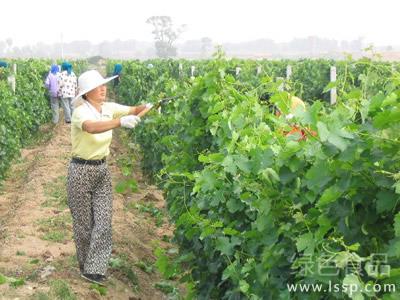
Grape summer pruning
1. Bud removal and shoot thinning:Bud removal is carried out as soon as grape budding begins, removing secondary buds and redundant, poorly positioned, or weak main buds to reduce nutrient consumption. Before the young shoots unfold their leaves, select and keep one strong shoot per bud eye and thin out the rest. Shoot thinning is carried out when the new shoots grow to about 20cm, selecting and keeping fruiting shoots and vegetative shoots, thinning out overly dense and overly weak shoots, and retaining fruiting shoots so that the new shoots do not overlap or cross. Keeping 16---20 new shoots per square meter of trellis surface is enough.
2. Pinching the tips of fruiting shoots:A few days before flowering, pinch off the tips of the grape fruiting shoots so that nutrients flow to the inflorescences, slowing the growth of the new shoots and raising the fruit-setting rate. For most grape varieties, it is best to start 3---4 days before flowering and continue until the beginning of flowering. For grape varieties with heavy berry drop and poor fruit set, pinching at the beginning of flowering gives the best effect. The degree of pinching should depend on the vigor of the fruiting shoot: leave 3—5 leaves above the inflorescence and pinch there, so that each fruiting shoot keeps 8—10 mature leaves. When pinching, remove the secondary shoots that sprout below the inflorescence.
Vegetative shoots are generally pinched after the fruiting shoots flower, leaving 10---12 leaves, and the extended canes of the main trunk are pinched in mid-August leaving 15---20 leaves; at the same time, all the remaining new shoots are pinched once as well.
3. Handling of secondary shoots:As the new shoots grow, the summer-bud secondary shoots sprout one after another and grow quickly, consuming nutrients and affecting ventilation and light penetration, so they should be dealt with in time. The methods are as follows:
(1) On a fruiting shoot, keep only one secondary shoot at the tip; pinch this secondary shoot repeatedly, leaving 3—4 leaves, and remove all the other secondary shoots entirely.
(2) For secondary shoots on vegetative shoots, keep 1—2 leaves and pinch repeatedly; keep 3—4 leaves on the one secondary shoot at the tip and pinch it repeatedly. Canes with too few leaves can appropriately keep a few more secondary-shoot leaves as a supplement.
The work of handling secondary shoots starts when the grape fruiting shoots are pinched, and is then carried out once every 10---15 days.
Grape
4. Thinning inflorescences and pinching flower tips:Properly thinning out excessive or underdeveloped inflorescences and removing inflorescences on reserve shoots can save nutrients and increase yield. For grape varieties with large inflorescences and a high rate of double clusters, keep 2 clusters on vigorous fruiting canes, generally keep 1 cluster, and keep no fruit on weak canes. For other grape varieties with many clusters, the small inflorescences at the front part of the cane can be removed. Pinching flower tips means pinching off 1/4---1/5 of the total length from the tip of the inflorescence with the fingers one week before flowering. Reducing the number of flower buds on the inflorescence can make the cluster compact, the berries uniform in size, and also reduce berry drop.
5. Removing tendrils and tying canes:Tendrils consume nutrients and are removed along with summer pruning. When the new shoots grow to about 40 cm, they must be tied to the trellis surface. When tying the canes, the new shoots should be distributed evenly and not crossed. About 40% of the new shoots can be tied to the trellis surface, and the rest left upright.
6. Shoot trimming:During July—August, if the new shoots grow too long and have too many leaves, about 30 cm can be cut off the top to improve ventilation and light conditions and reduce disease. At the same time, leaves damaged or attacked by pests and diseases should be cut off.
7. Cutting floating roots:Every year during July—August, dig open the buried scion part, cut off the roots growing from the scion at the base, expose them to the sun for two days, and then bank the soil back up. If the roots are not cut in time, the grafted grapevine will lose its cold resistance.