Watermelon is prone to Fusarium wilt during the fruit-setting stage; how can it be prevented and controlled?
The pathogen of watermelon Fusarium wilt is Fusarium oxysporum f. sp. niveum, a fungal soil-borne disease with severe incidence. Especially in continuous watermelon cropping land or during continuous rainy weather, watermelon Fusarium wilt occurs very easily and spreads rapidly during the fruit-setting stage of watermelon, affecting the quality and yield of watermelon.
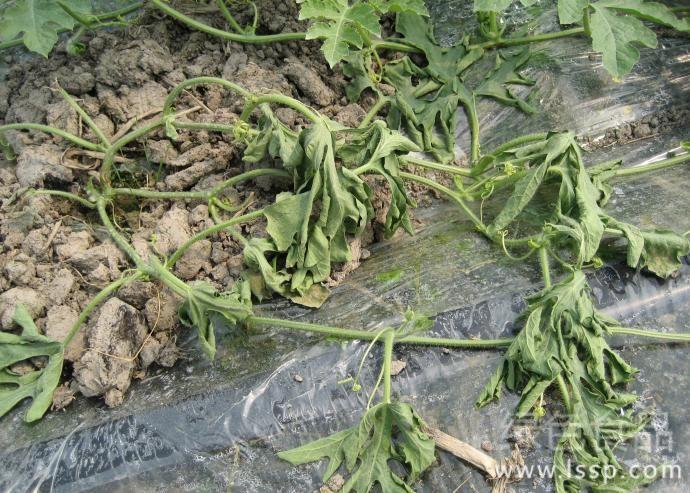
Watermelon Fusarium wilt
1. Symptoms and disease onset:In the early stage, watermelon leaves gradually wilt from the old leaves toward the front end, resembling a lack of water, most obvious at noon, and can recover in the morning and evening. After 3-6 d (days), the entire plant's leaves wilt and droop, cannot recover, and finally the whole plant dies. The base of the plant stem and vines becomes constricted, and some diseased parts develop brown lesions or amber-colored gelatinous material. The diseased roots turn brown and rot, the stem base splits longitudinally, and the vascular bundles on the longitudinal section of the diseased stem turn brown. When humidity is high, pink mold-like substances grow on the surface of the diseased parts.
2. Disease occurrence pattern:The pathogen mainly overwinters as mycelium and chlamydospores or sclerotia in undecomposed organic fertilizer or soil. This fungus can survive in soil for 6 years, and the sclerotia and chlamydospores still retain viability after passing through the digestive tract of livestock. During seed collection, chlamydospores can adhere to the seeds. When diseased seeds are sown, the pathogen invades watermelon seedlings after germination, becoming a secondary source of infection. Substances secreted by watermelon roots stimulate the germination of chlamydospores, which invade through the intercellular spaces at the tips of root hairs or through root wounds. They first grow inside cells or between parenchyma cells, then enter the vascular bundles and develop within the vessels, secreting pectinase and cellulase, destroying cells, blocking vessels, interfering with metabolism, and causing watermelon to wilt and die.
Chlamydospores can resist high and low temperatures and dry environments, and survive best in soil with 70% moisture or in red loam soil. The severity of watermelon Fusarium wilt depends on the amount of inoculum in that year. In production, disease is more severe in continuous cropping land with little sunlight, continuous rainy days, high rainfall, heavy clay soil, low terrain, poor drainage, and extensive management. In addition, excessive nitrogen fertilizer, insufficient phosphorus and potassium fertilizer, application of undecomposed pathogen-carrying organic fertilizer, or high calcium content in the soil, and severe damage by Aulacophora femoralis and underground pests can all easily induce Fusarium wilt.
3. Prevention and control measures
3.1. Use disease-resistant watermelon varieties: such as the Jingxin series, Zhemi series, Jinzhong Guanlong, Heijingang, Xinong No. 8, Julong, etc.
3.2. Crop rotation: rotate as much as possible with crops such as corn, sugarcane, and rice, and persist for 3-5 years without continuous cropping with melon and fruit crops.
3.3. Seed treatment: soak seeds in 150-fold 40% formaldehyde solution for 1-2 h (hours), or soak in warm water at 50-60 degrees C for 15-25 min (minutes) (stirring continuously with a wooden stick), to kill pathogens on the seed surface.
3.4. Cultivate strong seedlings: use disease-resistant rootstock grafting, raise seedlings in seedling pots to protect roots, cultivate strong seedlings, and avoid damaging the root system as much as possible during transplanting.
3.5. Reasonable fertilization: control the amount of nitrogen fertilizer applied, increase the application of phosphorus, potassium, and trace elements, and enhance watermelon disease resistance.
3.6. Chemical control: before disease onset, start spraying at the early fruit-setting stage with 200-fold 10% Shuangxiaoling aqueous solution, or 500-fold 50% carbendazim wettable powder, or 800-fold 70% dexon wettable powder, spraying 60 L (liters) of the prepared solution per 667 sq m (mu), once every about 10 d, for a total of 2-3 applications. Spraying must be done on a sunny afternoon to prevent burning the plant leaves. Diseased watermelon plants should be pulled out immediately, and the diseased planting holes and surrounding plants should be drenched at the roots with 500-fold 25.9% Kangkuling aqueous solution, or 200-fold 10% Shuangxiaoling aqueous solution, or 800-fold 75% Zhiweiling wettable powder. Drench each watermelon plant with 0.4-0.5 L of the prepared solution.