Corn severely stunted and unable to set seed: how to prevent and control rough dwarf disease
Corn rough dwarf disease, commonly known as "sitting on the slope," can occur at all growth stages of corn, is relatively common in early summer-sown corn fields, and does the most severe damage at the seedling stage. It begins at the base of the corn's rolled leaf and on both sides of the midrib, producing transparent, oil-soaked-looking chlorotic dashed lines and dots that gradually spread to the entire leaf. Diseased seedlings are dark green, grow slowly and are stunted, with broad, short, stiff leaves, dark green leaf color, short thick internodes, and a clustered rosette of top leaves. On the veins of the leaf underside, leaf sheath, and husk leaves, there are raised waxy-white streaks of varying thickness. From the 9-to-10-leaf stage, stunting becomes obvious. Most corn with rough dwarf disease cannot tassel or set seed; although a few individual tassels may emerge, they have very few branches and no pollen. The ear is deformed, with very few silks; in severe cases there is stunting, tassel degeneration, and ear deformity, and in severe cases no seed can be set.
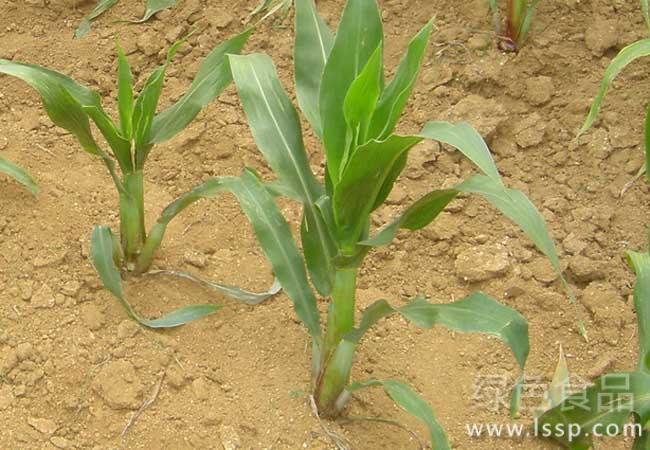
Corn rough dwarf disease
Prevention and control methods
1. Select disease-resistant varieties.Select corn varieties with relatively good resistance, and arrange the planting area rationally to avoid large-scale planting of corn of a single resistance source.
2. Clear weeds.Weeds along roadsides and in fields are not only a source of weed seed but also the overwintering and oversummering host of the small brown planthopper, the vector that transmits corn rough dwarf disease. Clearing weeds can, to a certain extent, reduce the harm of corn rough dwarf disease.
3. Strengthen field management.Along with thinning to a stand, pull up diseased plants in the field and bury them deeply or burn them in a centralized manner to reduce the sources of corn rough dwarf disease infection. Fertilize and water reasonably, strengthen field management, promote corn growth, shorten the susceptible period, reduce opportunities for virus transmission, and enhance corn's disease resistance and tolerance.
4. Spray insecticide to kill pests.First, do a good job of treating corn seed with chemicals before sowing. Coating and dressing corn seed with systemic insecticides can effectively control the small brown planthopper at the seedling stage and reduce the spread of rough dwarf disease. Second, spray insecticide to kill pests. When corn grows to the 2-leaf-1-heart stage, for fields found to have the disease, use the method of spraying insecticide + antiviral agent + foliar fertilizer for control. Insecticides include pirimicarb, buprofezin, imidacloprid, acetamiprid, etc.; antiviral agents include JunDuQing, Virus A, etc.; foliar fertilizers include potassium dihydrogen phosphate, PeiShiBao, etc. Dilute each according to its respective dilution ratio, spray once every 7 days, and spray 3 times in succession .