How to choose a fungicide? Master these key points for scientific disease control
How to choose a fungicide? Which fungicides are good? Please give an introduction. China's vegetable planting area has exceeded the planting area of oilseed crops, making vegetables a major crop in China. The biggest problem in vegetable production is the control of pests and diseases, especially disease control, which is a difficult problem in vegetable production. In vegetable disease control...
How to choose a fungicide? Which fungicides are good? Please give an introduction
China's vegetable planting area has exceeded the planting area of oilseed crops, making vegetables a major crop in China. The biggest problem in vegetable production is the control of pests and diseases, especially disease control, which is a difficult problem in vegetable production. In vegetable disease control, in addition to agricultural, physical, ecological and other control measures, chemical control is the measure we use most. Among chemical control methods, fungicides are used most widely and frequently. Among the various diseases of vegetables, whether seedling-stage diseases or diseases at other stages, downy mildew and Phytophthora blight occur most commonly. To control these two diseases, in the late 1980s and early 1990s, after China first introduced the substituted benzene fungicides metalaxyl and Ridomil, it then introduced amide fungicides such as Sandofan. Because this class of chemicals has significant protective and curative effects, it is now widely used in the control of downy mildew and Phytophthora blight and has played an important role in production. However, it should be pointed out that this class of fungicides has a single site of action, and once the site of action changes, it will inevitably lead to resistance in the pathogen. For a long time, cases of reduced efficacy due to resistance have been common. Production practice shows that in some traditional vegetable production areas, pathogen resistance is strong, and the dilution of fungicides used has been decreasing (currently down to 200-300 times), which not only greatly increases control costs, but also reduces control efficacy from the initial 70%-80% to the current 30%-40%. Therefore, many experts suggest that while comprehensively carrying out integrated control work, new pesticides should be selected scientifically and pesticides should be used alternately during control. In view of the above situation, two excellent environmentally friendly fungicides for controlling downy mildew and Phytophthora blight are recommended here to the broad community of farmers.
1. Acrobat. Acrobat is produced by the German company BASF, in the form of a 20% dry suspension concentrate, and in 2000 was recommended by the Pesticide Inspection Institute of the Ministry of Agriculture as the first-choice treatment for downy mildew and Phytophthora blight. This chemical has a triple control function: first, a preventive function, blocking pathogen invasion; second, a curative function, able to penetrate plant tissues and kill pathogens; third, an anti-sporulation function, preventing pathogen spore formation and avoiding reinfection of plants. Acrobat has good dispersibility, strong osmotic and systemic action, and resistance to rain washing; if it rains one hour after application, efficacy is unaffected, and the effective period reaches 7-10 days. It can quickly kill pathogens that have developed resistance to other fungicides. The dilution is 2500-3000 times, and it can be widely used on crops such as cucurbits, tomato, tobacco, potato, leafy vegetables, and legumes.
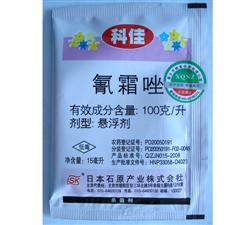
2. Tebuconazole? No. Kejia. Kejia is a pesticide produced by Ishihara Sangyo Kaisha, Ltd. of Japan, in the form of a 10% suspension concentrate, and has good control efficacy against downy mildew and Phytophthora blight. This chemical has high biological activity, with a dilution of 2500-3000 times, and can hinder the development of pathogens at all growth stages, belonging to the super-protective type of fungicide. Its chemical structure is unique (cyanoimidazole class), and its site of action differs from other fungicides, so it can effectively control pathogens that have developed resistance to commonly used fungicides such as Curzate, Sandofan, and metalaxyl. Its effective period can last up to 10-14 days. It is safe for crops, can be mixed with many pesticides, and is not afraid of rain after application. What is commendable is that this product is slightly toxic, does not harm beneficial organisms such as bees and lacewings, is safe for the ecological environment, and is an environmentally friendly green pesticide.
Click to get more fungicide application techniques
Click to get more pesticide application techniques