Downy blight is the most important disease of lychee. How is it controlled?
Lychee downy blight is the most serious disease of lychee. It damages lychee leaves, flower panicles, fruiting twigs, fruit stalks and young fruit, and lychee that is nearly ripe and ripe is especially severely affected. This disease can cause heavy fruit drop and fruit rot in lychee. The loss rate can reach 30%-80%.
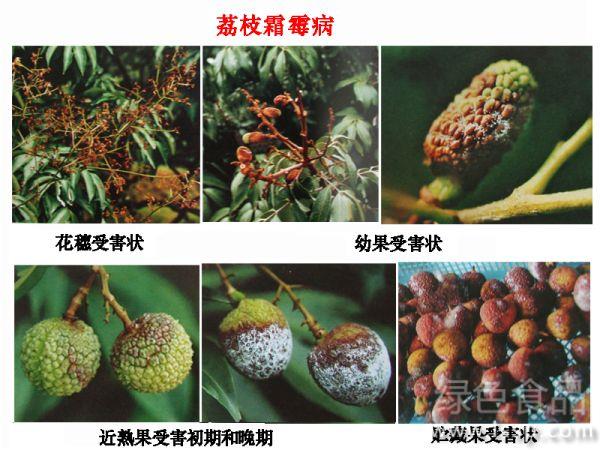
Lychee downy blight
To control lychee downy blight, agricultural control is the foundation and chemical control is the main approach, as follows:
1. Strengthen orchard management of the lychee plantation. Deep plow and earth up, apply organic fertilizer, improve soil structure, and repair the border furrows to facilitate drainage, improve the environment, reduce humidity, and increase the lychee plants' own disease resistance. At the same time, do a good job of pruning and training the lychee trees, thoroughly cutting out diseased and pest-infested branches and overly dense branches, so that the canopy is well ventilated and lets light through, reducing sources of disease and pests.
2. Clean the orchard to reduce the sources of primary infection of lychee downy blight. After harvesting the fruit, in combination with pruning, remove dead branches and shaded branches from the trees, and gather fallen leaves and fallen fruit on the ground to burn them.
3. Chemical control: Spray for control at the lychee flower bud stage, young fruit stage and mature stage. The number of sprays is decided according to the weather conditions at the time (especially rain) and the development of lychee downy blight. If there is continuous rain, seize fine weather to spray. The mature stage of lychee is the period of greatest susceptibility. Pay close attention to weather conditions and carry out spraying for protection. There are many fungicides for controlling lychee downy blight, but they easily lead to resistance, so rotate their use. The fungicides that can be selected include 64% Sandofan M8 wettable powder at 500-600 times dilution; 58% Ridomil MZ wettable powder at 800 times dilution; 25% Ridomil wettable powder at 800 times dilution; 90% fosetyl-aluminum (Aliette) powder at 500 times dilution; 40% fosetyl-aluminum (Aliette) wettable powder at 250-300 times dilution; 53% Gold Ridomil water-dispersible granules at 600-700 times dilution.