Tomato fruit drop caused by severe gray mold, how should it be prevented and controlled?
Tomato flowers, fruits, leaves and stems can all be infected by gray mold. When fruits are infected, green fruits suffer the most damage; the first parts to be infected are mostly the remaining stigma or petals, which then spread to the tomato or the fruit stalk, causing the tomato skin to turn grayish-white and become covered with a thick gray mold layer, taking on a watery rot appearance. Leaf gray mold mostly starts at the leaf tip first, then extends inward along the spaces between the lateral veins in a "V" shape; initially it appears water-soaked, and after expanding it becomes yellowish-brown, with the leaf edge showing alternating light and dark striped lines. The boundary between diseased and healthy tissue is distinct. When stems are infected with gray mold, small water-soaked spots appear first, later becoming oblong or strip-shaped lesions that are light brown. When humidity is high, the lesion surface is covered with a gray mold layer, and in severe cases it can cause the plant to die.
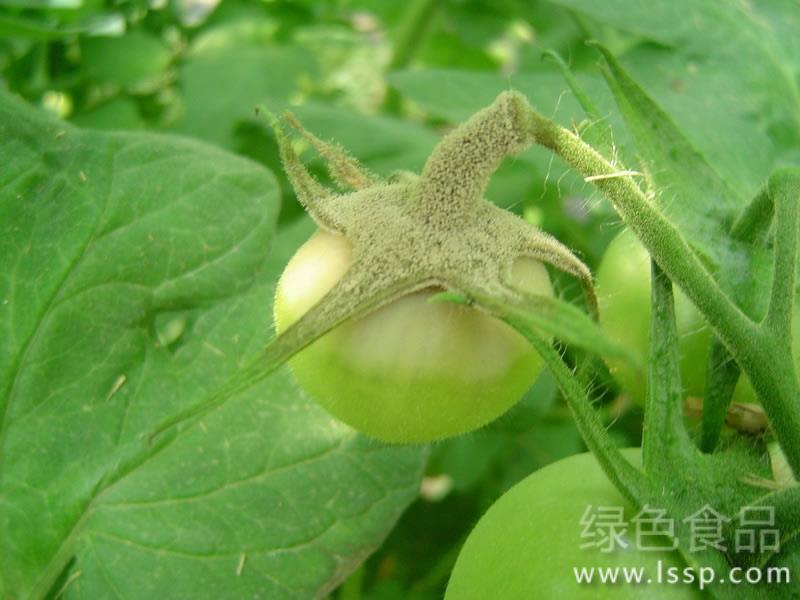
Tomato gray mold
Transmission routes and conditions for disease onset:Gray mold is caused by infection from the fungus Botrytis cinerea. At a temperature of 20-30°C and relative humidity above 90%, these are suitable conditions for the disease to occur. In protected tomato cultivation, the disease is generally prone to occur from December to May of the following year. The pathogen spreads through airflow, irrigation water and farming operations. The main human transmission route is flower dipping; the pathogen invades from wounds and dead tissues such as senescent organs, and the flowering stage is the peak period of infection.
Prevention and control methods:
Ecological control.In protected tomato cultivation, the main measure is to control the temperature and humidity inside the greenhouse. Generally, ventilation is delayed in the morning, and ventilation begins once the temperature exceeds 30°C; when it drops to 25°C, ventilation continues at noon, and in the afternoon the temperature is maintained at 20-25°C; when it reaches 20°C, ventilation is stopped, so that the nighttime temperature stays between 15-17°C. On cloudy days, open the vents to exchange the air.
Strengthen cultivation management. When transplanting, apply sufficient base fertilizer; avoid watering on cloudy and rainy days; after watering, ventilate to remove moisture; after disease onset, control watering; promptly remove infected tomatoes and leaves and dispose of them in a centralized manner; after uprooting the vines, clear away diseased plant residues, pay attention to hygiene in farming operations, and prevent infection.
Chemical control.Focus on applying chemicals at the three key stages: before tomato transplanting, at the flowering stage, and at the fruit enlargement stage.
(1) Before tomato transplanting, spray the seedlings with a 1500-2000 times dilution of 50% procymidone wettable powder, or a 500 times dilution of 50% carbendazim wettable powder.
(2) Flower dipping chemicals. After transplanting, apply chemicals together with flower dipping, that is, add 0.1% of 50% iprodione wettable powder or 50% carbendazim wettable powder, or 0.2%-0.3% of 25% metalaxyl wettable powder, to the prepared 2.4-D or 4-CPA dilution, and use it for dipping or smearing the flowers.
(3) Fruit-forcing chemicals. Apply chemicals before watering to force fruit growth or at the early stage of gray mold onset.
(4) Smoke application. You may choose 10% procymidone smoke agent or 45% chlorothalonil smoke agent, 250 grams per mu of tomatoes each time.
(5) Dust application. You may choose 5% chlorothalonil dust agent, 1 kg per mu of tomatoes each time, applied once every 7-10 days, for 2-3 consecutive applications.