Malabar spinach is heat-tolerant and grows rapidly: key points of summer and autumn cultivation techniques
Malabar spinach, also known as Ceylon spinach or vine spinach, is grown for its tender stems and leaves, which have high nutritional value. Because it is heat-tolerant and grows rapidly, it is suitable for summer and autumn and for quick-turnaround cultivation. Commonly used varieties include: red Malabar spinach, green-stemmed Malabar spinach, broad-leaved Malabar spinach, white-flowered Malabar spinach, and others. Depending on which part of the Malabar spinach is harvested for eating, cultivation is divided into no-trellis cultivation (harvesting tender tips) and trellis cultivation (harvesting tender leaves).
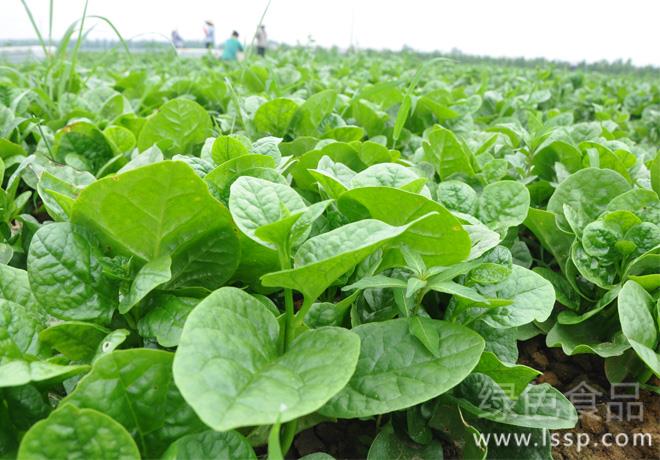
Malabar spinach
Before sowing Malabar spinach, apply 2500 kg of decomposed organic fertilizer and 450 kg of superphosphate per mu, plow deeply, rake level, and spray 200 grams of no-deep-plowing soil conditioner per mu to promote loosening and aeration of the deeper soil. Make flat beds. Before sowing, first soak the seeds in warm water at 35°C for 1-2 days; for summer and autumn cultivation, there is no need to promote germination. Broadcast 8 kg of seed per mu; the effective stand of Malabar spinach is 30,000 plants per mu.
After emergence, thin and then final-thin the seedlings. For leaf harvesting, the spacing between plants and rows is 30-40 cm × 40-60 cm, with 1-5 plants per hole; for tender-tip harvesting, the spacing between plants and rows is 15-20 cm × 30-40 cm, with 1-3 plants per hole.
After the Malabar spinach emerges, keep the soil moist and water it in a timely manner. After each harvest, promptly apply one topdressing of human feces and urine, 500 kg per hectare, or 10 kg of urea; in the rainy season, drain promptly to prevent waterlogging.
When harvesting tender tips, when the seedlings are 30-35 cm tall, leave 3-4 leaves and cut the first tips. After that, select and keep 2 strong, vigorous lateral buds to become tips, and remove the rest. After cutting the second round of tips, again keep 2-4 strong lateral buds to become tips, and remove the rest. During the period of vigorous growth, 5-8 strong lateral buds may be selected and kept to become tips. In the middle and late stages, Malabar spinach should have flower buds removed at any time. At the end of the harvest period, 1-2 strong lateral buds may be kept to become tips.
For cultivation for leaf harvesting, trellises should be set up for the vines to climb, and the main framework vines should be selected and kept; in addition to the main vine, select strong lateral buds at the base to become vines. When the framework vines grow to the top of the trellis, pinch off the growing tip. After pinching, again select and keep strong lateral buds from the base of the Malabar spinach's framework vines to become vines.
40-50 days after sowing, harvest tender leaves for eating; generally, in the early stage, harvest once every 15-20 days; in the middle growth stage, every 10-15 days; in the late stage, every 10-17 days. When harvesting tender tips, cut with a knife or scissors, preferably at a length of 10-15 cm, harvesting once every 7-10 days. It is also possible to cut tender tips in the early and late stages and harvest tender leaves in the middle stage.
The disease that commonly occurs on Malabar spinach is: brown spot, also known as fish-eye disease, red spot disease, snake-eye disease, sun spot, and others. In the early stage of occurrence, spray 600 times dilution of 72% Kelu wettable powder, or 1000 times dilution of 68.75% Yibao dispersible granules for control.