Walnut branch blight is highly prevalent in summer: how to prevent and control it
The acervuli or mycelium overwinter on diseased parts of walnut branches and trunks. When conditions are suitable in spring of the following year, the conidia produced are spread by wind and rain and by insects, causing primary infection through walnut wounds or tender shoots and leading to branch blight; after walnut branch blight develops, more spores are produced for secondary infection. The disease occurs from May to June, peaks in July-August, and stops after September. Walnut branch blight is more severe in years with high air humidity and abundant rain, and young walnut trees that have suffered serious freezing injury and shoot dieback are susceptible. This fungus is a weak parasite, and weak-growing walnut branches are prone to the disease; in years with spring drought or freezing damage, the disease is severe.
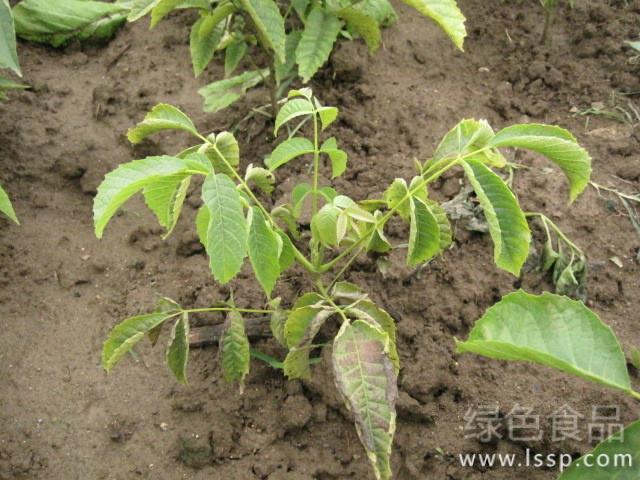
Walnut branch blight
Control methods:
1. Strengthen walnut orchard management, increase fertilizer and water application, enhance tree vigor, and improve disease resistance.
2. Thoroughly remove diseased plants and dead branches, and burn them in a centralized manner. Pruning should be carried out after walnut leaf expansion and before leaf fall; during the dormant period, branches should not be pruned or sawed, as this causes bleeding and leads to dead branches and dead trees.
3. Whitewash walnut trunks in winter or early spring. Whitewash preparation: quicklime 12.5kg, salt 1.5kg, vegetable oil 0.25kg, sulfur powder 0.5kg, water 50kg.
4. Scrape off diseased spots. If diseased spots are found on the main trunk of walnut trees, scrape them off with a knife, disinfect the wounds with 1% copper sulfate, and apply the following agents: 50% thiram wettable powder 30-50 times dilution; 3-5 degrees Baume lime sulfur mixture; 0.15% wuningmycin aqueous solution 200-300 times dilution; 5% jun du qing aqueous solution 50-100 times dilution, applied for disinfection.
5. During the walnut growing season, the following agents can be sprayed: 70% thiophanate-methyl wettable powder 800-1000 times dilution; 45% amobam aqueous solution 800-1000 times dilution + 50% carbendazim wettable powder 500-800 times dilution; 70% mancozeb wettable powder 800-1000 times dilution + 50% iprodione wettable powder 800-1000 times dilution, sprayed once every 10-15 days, 2-3 times in total; the above agents should be used alternately.