Pear black spot disease affects fruit appearance; how to control it scientifically?
Pear black spot disease is also called black bottom disease. According to research and identification, Trichothecium roseum is the pathogen of black spot disease. The pathogen enters the pear bag along the pear fruit stalk with rain, fog, and liquid sprays, and gathers at the calyx depression. After bagging, the humidity inside the bag is high and air permeability is poor, which is suitable for the growth and reproduction of Trichothecium roseum. The rainy season from late June to late July is the peak period of disease occurrence. In the early stage of the disease, tiny black spots the size of needle tips appear around the calyx depression of the pear. As the symptoms develop, the diameter of the black spots expands, and multiple black spots connect together to form nearly circular sunken spots surrounding the lenticels. The lesions occur only on the pear skin and do not cause the pear flesh to rot. In the later growth stage and storage period of the pear, the black spots expand and become slightly sunken. Black spot disease mainly occurs on pear trees such as Lyubao and Huangguan.
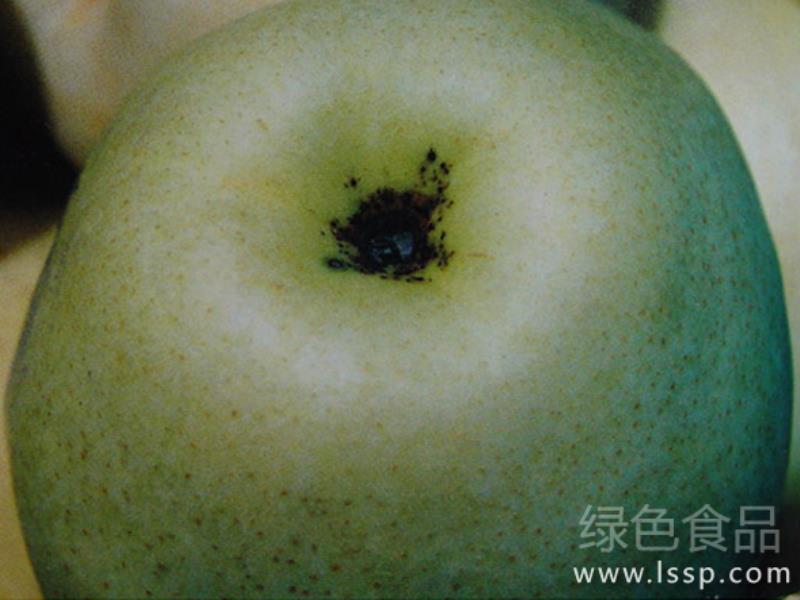
Pear black spot disease
I. Causal factors
Research investigations show that the climatic conditions in June and July of that year are directly related to how early and how severely pear black spot disease occurs. The main causes of black spot disease are excessive air humidity and excessive humidity inside the fruit bag. When there are many cloudy and rainy days and heavy precipitation, the disease is severe; conversely, the disease is mild or unlikely to occur. Investigations have found that the poorer the air permeability of the fruit bag, the higher the incidence of pear black spot disease. In pear orchards with high humidity, poor ventilation and light transmission, severe crowding, and excessive nitrogen fertilizer application, the incidence of black spot disease is higher.
II. Control methods
Pear black spot disease should be controlled mainly through prevention, and pear orchard management should be strengthened.
1. Strengthen orchard sanitation in the pear orchard. For sanitation, use the broad-spectrum fungicides Mengfuli (80% mancozeb) or Chunbanlun (80% tebuconazole) to spray the entire pear tree; diseased and residual branches in the pear orchard must be cleaned up thoroughly.
2. Do a good job of pruning the pear orchard, improve light transmission and air permeability in the orchard, and reduce humidity within the orchard;
3. Supplement calcium during the young fruit stage. Before bagging the pears, spray organic calcium once every 7-10 days, for 2-3 consecutive sprays;
4. Do a good job of chemical prevention. After pear petals fall, promptly use Mengfuli 600-800 times dilution for prevention. Before bagging the pears, use a highly effective fungicide, and the interval between spraying before bagging should be less than 10 days. At this time, Yehumei (25% azoxystrobin) 1000-1500 times dilution can be used. Spray to ensure quality and quantity, evenly and thoroughly, and spray the fruit surface and both the front and back sides of pear leaves.
5. Bag the fruit in a timely manner. When bagging, choose fruit bags with good air permeability and light transmission.