Tomato hollow fruit causes yield reduction, how to scientifically prevent and control it?
Tomato hollow fruit refers to the presence of cavities between the fruit skin and the gelatinous flesh. There are three common types: poor placenta development, with very thin pericarp septa and no visible seeds; varieties with fast-growing pericarp septa and few locules, where inflorescences at higher nodes are easily seen; and rapid pericarp growth and development, where placenta development cannot keep up, resulting in tomato hollow fruit.
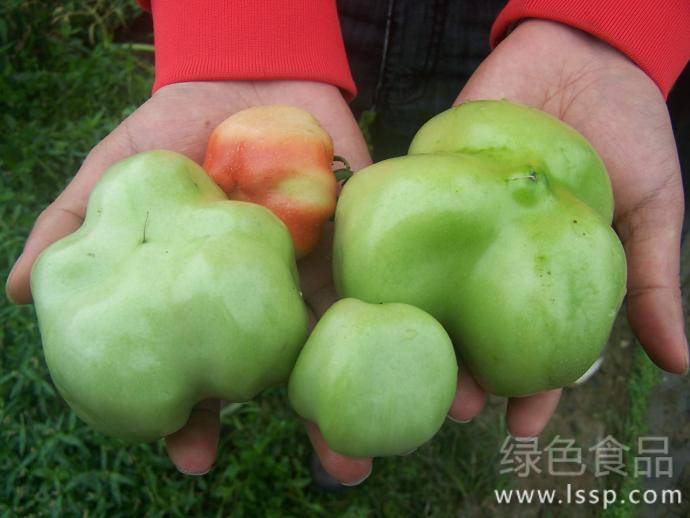
Tomato hollow fruit
Causes: Under low temperature conditions, the tomato root system has low vigor and poor water absorption. If the young tomato fruit is at the expansion stage at this time, short-term water shortage can easily lead to hollow fruit. In low-temperature seasons, watering in protected facilities lowers the temperature and can easily cause hollow fruit. When the temperature is too low, even if flower-spraying agents are used, although the fruit sets, the root system has poor absorption capacity and nutrient supply is insufficient, so the tomato cannot develop normally or fill out and expand, forming hollow fruit. If the concentration of the flower-dipping agent is too high, the tomato expands rapidly, placenta development cannot keep pace, and hollow fruit also appears. Tomato varieties with high fertilizer requirements, especially large-fruited types, may develop hollow fruit during the expansion stage if they cannot receive sufficient fertilizer and water supply. In addition, if nighttime temperatures are too high and nitrogen fertilizer is excessive, hollow fruit can also occur.
Prevention and control methods: Strengthen water and fertilizer management. For tomato irrigation in low-temperature seasons, the water must be pre-warmed by more than 10°C. A water storage tank can be built in the facility to temporarily store irrigation water to help raise the temperature. On the premise of ensuring normal growth, water control should be the main approach. Before flowering, maintain a medium moisture level, with soil moisture content of 6% to 75%; during the fruiting stage, the soil should be kept moist, with soil moisture content between 75% and 85%.
Generally, start watering and fertilizing when the tomatoes grow to the size of a walnut. Biological organic fertilizer or compound fertilizer can be applied by flushing with water. Applying single nitrogen fertilizer as a top dressing is prohibited. A large amount of elements should be supplemented. Among nitrogen, phosphorus, and potassium fertilizers, nitrogen and potassium should be dominant, coordinating the vegetative growth and reproductive growth of tomatoes. For base fertilizer, generally apply 4000 kg of decomposed manure or barnyard manure, 40 kg of compound fertilizer, and 30 kg of superphosphate per 667 sq m. For top dressing, apply lightly before fruit set and heavily after fruit set, and apply in split doses. In terms of fertilization, attention should be paid to increasing the application of phosphorus and potassium fertilizers, and do not abuse flushing fertilizers or foliar fertilizers with high hormone content.
Strengthen ventilation and light penetration. In the middle and late growth stages, appropriately prune side shoots and remove leaves to enhance light exposure and promote ventilation. Usually, after tomatoes on the fruiting branch are harvested, the side shoots below them should be removed promptly to ensure nutrient supply, and at the same time all leaves below the fruiting branch should be removed. Leaves on the fruit cluster must not be removed, so as to ensure the good development of the upper tomatoes. It should be noted that leaf removal in the middle and late stages should be moderate. While enhancing light and promoting ventilation, leaves should not be removed too early or too many; otherwise, the photosynthetic area will be insufficient, photosynthetic product accumulation will be low, nutrient supply will be inadequate, tomato development will be poor, and hollow fruit will appear.
Strengthen light management. During summer cultivation, the shading rate of the shade net must not be too high, generally not higher than 30%. On cloudy days, it should be uncovered in time. When carrying out overwintering cultivation in facilities, the covering cannot be uncovered at any time. In this case, it is better to use a gray shade net or gauze net; old plastic film can also be covered on top to block light and rain, with gauze net on the sides for ventilation and insect control. If the light saturation point cannot be reached for a long time, fewer photosynthetic products will be produced, and it will be impossible to meet the nutrient needs of stems, leaves, and tomatoes.