Broad bean fusarium wilt is difficult to control once it occurs; how should it be prevented and treated?
Fusarium wilt is one of the more common diseases of broad beans in recent years, and it is very difficult to control once it occurs. Fusarium wilt can appear from the emergence of broad bean seedlings through the flowering stage, causing root rot, stunted plants, pale yellow leaves, and a wilting appearance; the top stems and leaves wilt and droop, and the leaves fall off; the roots turn black, with very few lateral roots, and the main root is short, dark brown, shaped like a rat's tail, and the plant is very easy to pull up.
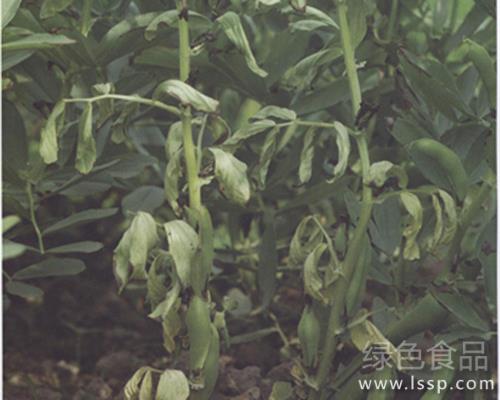
Broad bean fusarium wilt
Chemical control: (1) Disinfect broad bean seeds; one day before sowing, use 25 g of 50% carbendazim mixed with 150-200 ml of water, then mix with 6 kg of seed; or use 25 g of 35% metalaxyl per 1000 kg for seed dressing.
(2) Seed dressing: 75% chlorothalonil wettable powder at 0.2% of the seed amount (that is, 4 liang of pesticide for 100 jin of seed; first mix the 4 liang of pesticide with 3 jin of water to make a liquid, then sprinkle it on the broad bean seeds, stirring while sprinkling so that the liquid is evenly distributed on the seed surface, and sow after drying.
(3) Root drenching. In the early stage of broad bean fusarium wilt, the following agents can be used for root drenching: 50% carbendazim wettable powder at 500-600 times dilution; 10% shuangxiaoling aqueous solution at 1500-2000 times dilution; 25% propiconazole emulsifiable concentrate at 2000-3000 times dilution; 45% thiabendazole suspension concentrate at 1000 times dilution + 95% fenaminosulf wettable powder at 800 times dilution for root drenching.