How to prevent and control watermelon anthracnose? Temperature and humidity affect disease development
The causes of watermelon anthracnose are closely related to temperature and humidity. The most suitable temperature is 22-27°C. Below 10°C and above 30°C, the lesions stop growing. At the suitable temperature, the higher the humidity, the more severe the disease. When the relative humidity is 85-95%, the incubation period of the watermelon anthracnose pathogen is only 3 days; the lower the humidity, the longer the incubation period. When humidity drops below 54%, the disease does not occur.
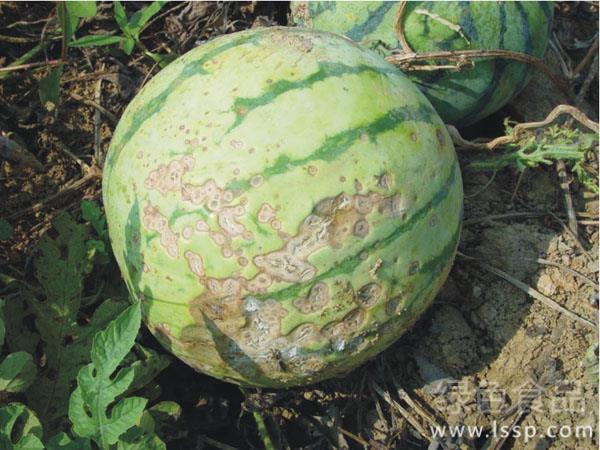
Watermelon anthracnose
Symptoms of anthracnose: It mainly harms watermelon leaves, and can also harm stems and vines, petioles and fruits. It can occur throughout the entire watermelon growing period, but is more severe during the middle and late growth stages, causing leaf drop and death, and fruit rot. When the disease occurs at the seedling stage, semi-elliptical brown lesions appear on the edges of watermelon cotyledons, spread to the young stems, and the seedlings damping off. At the adult plant stage of watermelon, the leaves initially show water-soaked lesions, which quickly dry up and become dark brown, with a yellow-brown halo on the outside, sometimes with concentric rings, and later become irregular. When dry, the lesions break apart easily; when humid, pinkish-red dots grow on the underside of the leaves, later turning black. Lesions on stems are spindle-shaped, sunken, with the center fading in color. When fruits are affected, water-soaked dark green spots first appear, and after expanding they become round or elliptical, dark brown, sunken lesions with cracking. When humid, pink sticky material is produced in the center of the lesions. In severe cases, a large number of lesions appear on the watermelon, causing the flesh under the skin to dry-rot and leading to fruit rot.
Control period: late May to early August.
Control methods: Give priority to agricultural control, reduce pesticide use, and lower pesticide residues.
1. Agricultural measures. Rotate with non-cucurbit crops for more than 3 years: select disease-resistant varieties, disinfect seeds properly, and cultivate disease-free strong seedlings; use rational formula fertilization, apply more organic fertilizer and potassium fertilizer, reduce the amount of nitrogen fertilizer, and must use fully decomposed organic fertilizer; do not use pathogen-carrying fertilizer; use plastic film mulching, prune scientifically, prevent excessive density, and avoid flood irrigation; diseased fruits and diseased leaves should be removed promptly, taken out of the field, and deeply buried or burned; during the rainy season, pay attention to timely drainage, place grass under the watermelons, and avoid direct contact between watermelons and the ground; plant growth regulators or foliar fertilizers may be sprayed appropriately to enhance the disease resistance of watermelon plants.
2. Chemical control. In the early stage of watermelon anthracnose, spray for control with 10% difenoconazole water-dispersible granules at 1500 times dilution, 50% prochloraz manganese salt wettable powder at 1000 times dilution, 70% thiophanate-methyl wettable powder at 500-700 times dilution, 50% carbendazim wettable powder at 500 times dilution, 80% anthracnose Fumei wettable powder at 800 times dilution, 80% mancozeb wettable powder at 500 times dilution, or 2% agricultural antibiotic 120 aqueous solution at 150-200 times dilution, spraying once every 7-10 days, for 3-4 consecutive sprays.