How to prevent and control rice false smut that contaminates rice grains and affects yield
Rice false smut is one of the main diseases of rice in the eastern Hebei rice-growing region. This disease not only directly affects rice yield, but also seriously contaminates rice grains with the pathogen, affecting human and animal health after consumption.
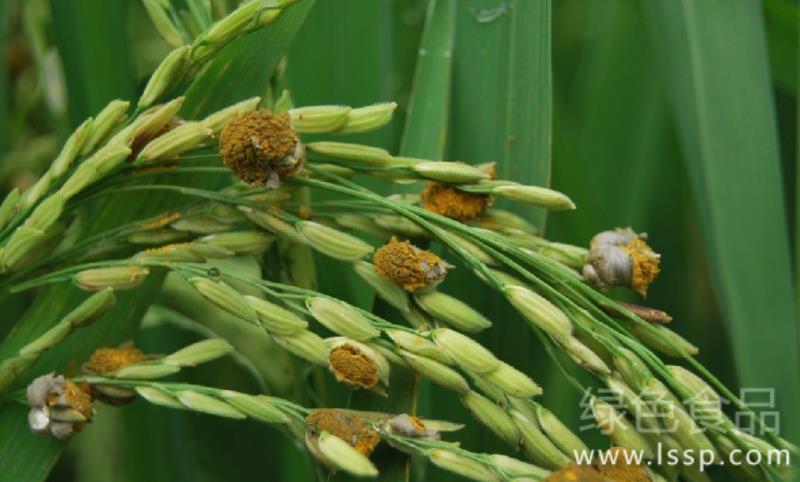
Rice false smut
(1) Symptom identification
Rice false smut is a fungal disease caused by Ustilaginoidea virens. The black grains it produces are large and very easy to identify.
(2) Occurrence pattern
The pathogen mainly overwinters in rice fields as sclerotia, and some diseased grains mixed in with seeds or pathogen spores attached to seeds also overwinter. When conditions are suitable the following year, the sclerotia germinate, and the produced spores spread through airflow, infecting the florets and young glumes of rice that are currently flowering. This is called infection at the flowering stage. After rice flowers close their glumes, the pathogen generally can no longer invade. Symptoms begin to appear during the flowering and grain-filling stage of rice. In the field, the disease generally occurs more severely at the edges and corners. Excessive nitrogen fertilizer application, lush and tender green growth in the late stage of rice, and rainfall and high temperatures during the flowering stage lead to more severe disease. The optimum temperature for pathogen development is 26-28°C.
When susceptible varieties are planted, when ear fertilizer is applied too late or in excessive amounts, causing rice to grow too lush and tender green after heading, and when continuous rainy and high-humidity weather occurs during the flowering stage, large-scale outbreaks of the disease are likely. In the 1980s, rice false smut was very severe; from 1990 to 1993, it occurred very lightly, making experiments difficult. However, after switching to the variety Jijing 14 in 1994, the disease became prevalent again that year, so the relationship with varieties is also very significant.
(3) Control measures
The prevention and control of rice false smut focuses on prevention. First, rational fertilization to ensure healthy and robust growth of rice plants. Second, applying fungicides early before the rice panicle emerges from the boot for chemical protection. This is the key.
Fungicides for controlling rice false smut can be divided into copper-based fungicides, organic fungicides, and biological fungicides. Organotin formulations are now banned by the state and will not be introduced.
(1) Copper-based fungicides: 30% DT (100-150 g/mu), 14% copper ammonia complex aqueous suspension (350-400 ml/mu), 23% copper ammonia complex (125 ml/mu), 27.12% Tonggaoshang (basic copper sulfate 30-50 ml/mu).
Application is required 3-10 days before the rice panicle emerges from the boot (approximately from when the flag leaf just tips out to when the flag leaf is fully extended, ideally when the flag leaf ligule is level with the ligule of the second leaf from the top). Within this period, the earlier the application, the better. DT and copper ammonia complex must not be applied after the rice panicle has emerged from the boot, nor mixed with other fungicides, otherwise phytotoxicity will occur. However, Tonggaoshang can be mixed.
(2) Organic fungicides: 10% Yangsheng (hexaconazole) 40 g/mu, 12.5% Heguoli (diniconazole) 20 g/mu, sprayed 3-5 days before the rice panicle emerges from the boot.
(3) Biological fungicides (antibiotic types): 5% jinggangmycin aqueous solution 150-200 ml/mu, which also controls rice false smut and sheath blight. More than 2 applications are needed: spray once when the rice flag leaf just tips out, and spray again a few days later.