Summer Chinese Cabbage Fills a Market Gap: How to Prevent and Treat Failure to Form Heads
In recent years, vegetable growers have used the summer fallow period of plastic greenhouses to grow Chinese cabbage, making it available year-round, and because Chinese cabbage grows quickly and has a short cycle, it brings high economic returns. However, depending on differences in planting and management methods, large numbers of summer Chinese cabbage fail to form heads. Many vegetable growers ask about the causes of Chinese cabbage failing to form heads and how to overcome them. The answer is given below:
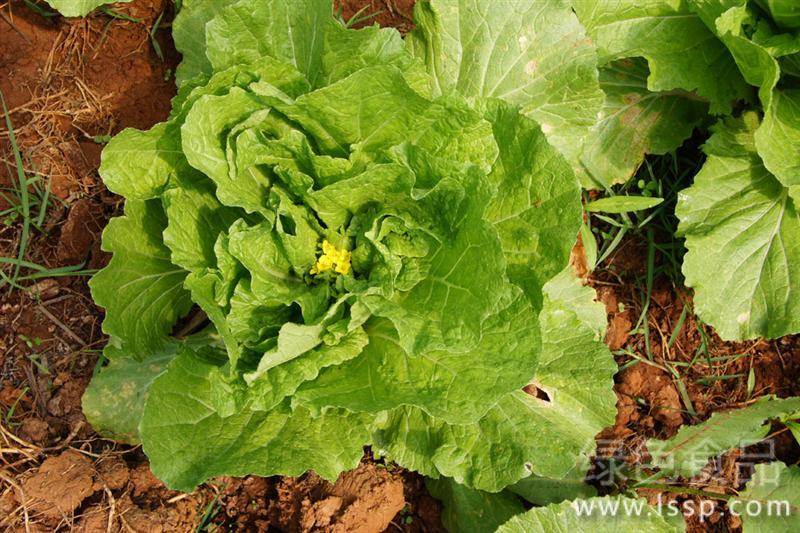
Chinese Cabbage Failing to Form Heads
Causes of failure to form heads:
Improper fertilization: summer temperatures are high, and many vegetable growers apply too much nitrogen fertilizer and too little phosphorus and potassium fertilizer to speed up the growth of Chinese cabbage, resulting in excessive nitrogen and insufficient phosphorus and potassium, so the Chinese cabbage fails to form heads or forms loose heads.
Uneven moisture: summer temperatures are high and Chinese cabbage grows rapidly, so its water demand is high. If it cannot be watered promptly and evenly, Chinese cabbage is prone to failing to form heads.
Heavy rain and high humidity: summer has a lot of rain and the field humidity is relatively high, which affects the growth of Chinese cabbage and makes it prone to failing to form heads.
Pests and diseases: in summer, pests and diseases of Chinese cabbage occur frequently, especially soft rot, dry heart rot, downy mildew, powdery mildew, viral disease, aphids, cabbage caterpillars and so on, which affect the growth of Chinese cabbage and cause it to fail to form heads.
Countermeasures:
Fertilize rationally. During the head-forming stage of Chinese cabbage, apply more phosphorus and potassium fertilizer and organic fertilizer and control nitrogen fertilizer to suppress excessive growth. Generally, at the early and middle stages of head formation, apply potassium dihydrogen phosphate or a ternary compound fertilizer once each time, at 10-15 kg per mu each time, applied with irrigation water.
Water scientifically: during the head-forming stage of Chinese cabbage, supply water evenly and adequately, and by no means let it be sometimes more and sometimes less, to prevent alternating dry and wet conditions, and keep the soil moist. Water once with clear water in the morning and once in the evening, and never water at noon. At the same time, cover the bed surface with weeds 3-5 cm thick to reduce water loss and keep the soil moist.
Prevent and control pests and diseases: during the head-forming stage of Chinese cabbage, inspect the leaves frequently. When damage from downy mildew, soft rot and the like is found, spray at the early stage of the disease with a 200-300 times dilution of 40% phosethyl-Al wettable powder, or a 500-600 times dilution of 50% metalaxyl-mancozeb, or a 600-800 times dilution of 50% methylamyl copper wettable powder, once every 7-8 days, and 2-3 consecutive treatments will suffice. Apply foliar fertilizer in time: during the heading stage of Chinese cabbage, every 7-10 days spray the leaves once with an 800 times dilution of the vegetable-specific Gaomei Shi organic humic acid active liquid fertilizer, or a mixture of 0.3% urea and 0.3% potassium dihydrogen phosphate, for 2-3 consecutive sprays, evenly wetting the leaves, which can effectively promote head formation in Chinese cabbage.
Install shade netting: after sowing summer Chinese cabbage in a greenhouse for the summer-to-autumn crop, install silver-gray or black shade netting on the front slope of the greenhouse, which can significantly lower the temperature inside the greenhouse and is beneficial for head formation in Chinese cabbage.