How to prevent and control the frequent occurrence of deformed fruit in pink-fruited tomatoes
Deformed tomato fruit has always plagued many vegetable growers, especially for pink-fruited tomatoes, where deformed fruit is very common. Common deformed tomato fruits include multi-locular deformed fruit, lumpy pointed fruit, and hollow fruit.
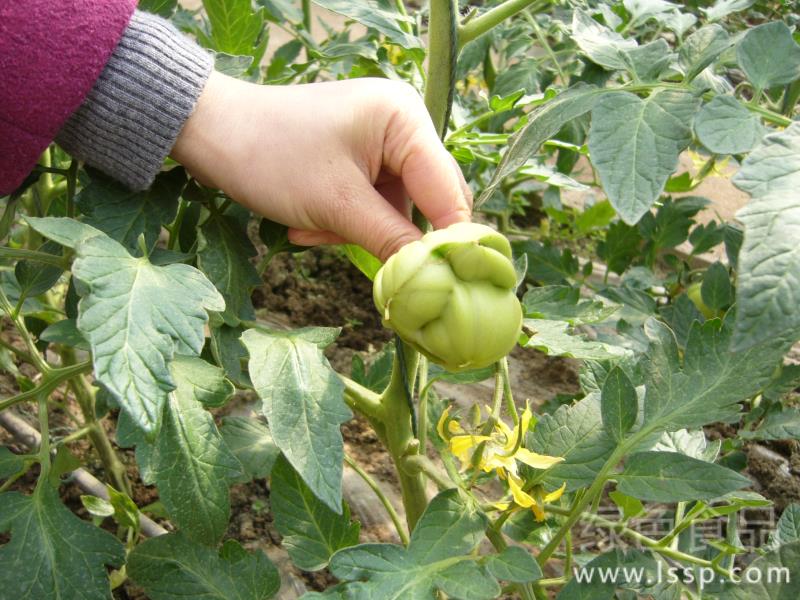
Deformed tomato fruit
I. Causes of deformed tomato fruit:
1. When flower bud differentiation and development encounter a continuous low night temperature of 5-6°C or 3-4°C, deformed fruit is easily produced; the easy deformity of the 1st to 2nd trusses of winter-spring tomatoes is mostly caused by this;
2. Prolonged seedling age, with a long period of low temperature or drought, causes tomato seedlings to be inhibited in growth for a long time, and the floral organs become suberized; later, even though suitable conditions exist, the suberized tissue cannot keep up with the growth rate of normal tissue, thus forming cracked fruit, fruit with exposed seeds, or scarred fruit;
3. Excessive application of nitrogen fertilizer; too much nitrogen fertilizer causes excessive differentiation of tomato flower buds and an increased number of locules, resulting in multi-locular deformed fruit;
4. Improper use of hormones. To prevent tomato flower and fruit drop, 2,4-D or Tomatotone is often used for flower dipping, but inaccurate concentration control, repeated dipping, high temperature during dipping, and soil drought all easily produce deformed tomato fruit. When the flower has not yet opened, dipping easily produces hollow fruit. In addition, when the seedlings are leggy, a high concentration or frequent use of plant growth regulators restrains the seedlings, and when flowers are then dipped, deformed fruit is also easily produced.
II. Prevention and control methods:
1. Strengthen seedling-stage management. Cultivate strong seedlings of the appropriate age; after the seedlings emerge, it is advisable to control the daytime temperature at 20-25°C and the night temperature at 13-17°C, keep the soil moist, and produce strong tomato seedlings of the appropriate age with short internodes in about 30 days;
2. The first fruit of the 1st to 3rd trusses is prone to forming deformed fruit and should be thinned out before flower dipping;
3. Strengthen fertilizer and water management. When fertilizing, nitrogen, phosphorus, and potassium should be used together, with formula fertilization, and excessive application of nitrogen fertilizer must be avoided. At the same time, water according to the growth vigour, appearance, weather, and water needs of the tomato plants, and never let the soil alternate between dry and wet;
4. The best time for flower dipping is when the tomato flowers are fully open on the same day; dip as soon as they open, and add red color or ink to the solution as a marker to avoid repeated dipping. The flower dipping work should be finished before 11 a.m. Since 2,4-D is not as stable as Tomatotone, when using 2,4-D it is advisable to use the method of holding the calyx and flower stalk. Prepare the flower dipping solution flexibly according to temperature: when the temperature is high, the concentration should be lower, and when the temperature is low, the concentration should be higher;
5. Tomatoes need rational use of growth regulators. When seedlings are leggy, that is, when vegetative growth is excessive, do not overuse measures such as lowering temperature, drought-based seedling control, or abuse of growth regulators; instead, on the basis of strengthening ventilation and appropriately controlling humidity, spray 800-fold Fengshou No. 1 once or twice.