How to control rice sheath blight that reduces 1000-grain weight?
Sheath blight is one of the three major diseases of rice worldwide. After infecting rice, it causes premature drying of rice leaves and poor growth, thereby reducing the 1000-grain weight and increasing the rate of blighted grains, with a major impact on yield. Yield is generally reduced by 5-10%, and in severe cases by 50-70%.
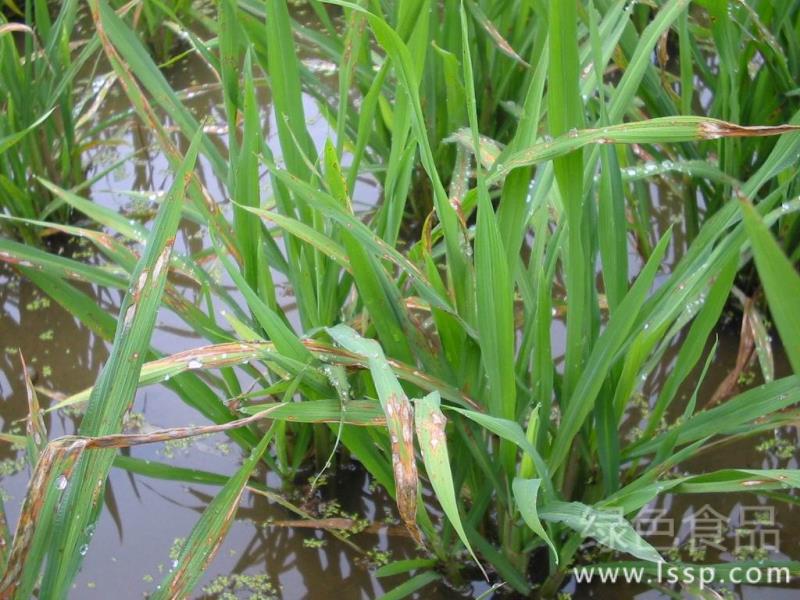
Rice sheath blight
(1) Pathogen and symptoms
The pathogen is a fungus, Rhizoctonia solani, which mainly damages the leaf sheaths and leaves of rice. In the early stage, it occurs on the lower leaf sheaths, first appearing as elliptical dark green water-soaked lesions, which then gradually expand into cloud-like patterns with brown edges and grayish-white centers. The lesions appear to have a blue sheen and turn grayish-green when moist. In the later stage of rice growth, it gradually spreads upward, and in severe cases the entire plant dies. Flat brown sclerotia are produced at the lower diseased leaf sheaths, and the sclerotia easily fall off.
Differences from saline-alkali damage symptoms: Sheath blight at the rice seedling stage is similar in symptoms to saline-alkali damage. The difference is that sheath blight generally first occurs in patches at the edges and corners of the paddy field, the lesions are mostly above the water surface, and the diseased tissue surface has a blue luster. Saline-alkali damage generally occurs uniformly throughout the field, a layer of white salt crust is visible on the surface of necrotic leaf sheaths, the lesions are mostly near the water surface, and there is no blue luster.
(2) Occurrence pattern
Sclerotia overwintering in the field soil are the main primary infection source. The disease generally starts at the edges and corners of the field. After rice transplanting, sclerotia drift with the water and attach to the leaf sheaths at the base of rice plants, germinate, and infect the basal leaf sheaths of rice. The pathogen requires relatively high temperature and humidity for development, with an optimum temperature of 28-32°C (2-4°C higher than rice blast), and an optimum relative humidity above 96%. From the peak tillering stage to the early booting stage, the disease spreads horizontally between rice plants or hills, and then spreads vertically from the lower part of the plant to the upper part. Fields with excessive nitrogen fertilizer application, long-term deep water flooding, and excessive rice planting density have severe disease occurrence.
Among previously planted varieties, the Yanfeng series, 10 You 18, Kendao 2015 and other varieties are all highly susceptible to rice false smut.
(3) Control methods
During spring puddling and harrowing, remove sclerotia and other debris floating on the water surface at the corners of the field, take them outside the field and burn or bury them deeply to reduce the inoculum source. During the horizontal spread stage of the disease, when the rate of diseased hills reaches 20%, spray fungicides for treatment. The key to control is to act early (spray at least once before jointing) and spray well (sufficient water volume, accurate dosage).
(1) Use 100-200 ml of 5% validamycin aqueous solution per mu.
(2) 10% diniconazole (Yangsheng) 40g/mu.
(3) 12.5% hexaconazole (Heguoli) 20g/mu. Dilute with 15-25 kg of water and spray, apply again after about 10 days, generally requiring 3 consecutive applications.
(4) 50% propiconazole 8-10ml/mu.
(5) Aimiao (difenoconazole/propiconazole) also has a concurrent control effect on rice sheath blight; use it twice consecutively.