Summer open-field cultivation techniques for amaranth: grow the star of the summer table
Amaranth, also known as green fragrant amaranth, red amaranth, wild thorn amaranth, and rice amaranth, is grown for its tender leaves and originated in China; it is a major leafy vegetable of summer.
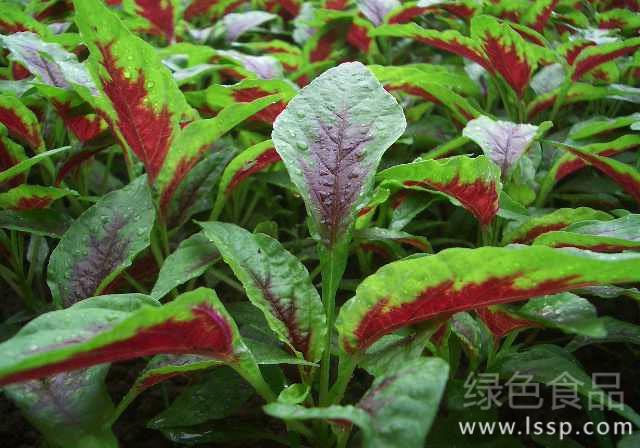
Amaranth
I. Choosing varieties.For summer open-field planting, choose large-leaf red amaranth, round-leaf amaranth, pointed-leaf red amaranth, and others with strong heat tolerance, strong drought tolerance, relatively strong disease and pest resistance, high yield, and good quality. ① Large-leaf red amaranth. The whole plant has 14 leaves; the leaves are relatively large, long-ovate, with nearly entire margins, dark purplish red, and green around the leaf edges; the stem is light green; the stems and leaf flesh of young plants are thick and tender, suitable for cooking and with a distinctive flavor. About 40 days after sowing, it can be harvested. Yield per mu is 2500 kg. ② Round-leaf amaranth. The whole plant has 15 leaves; the upper surface of the leaves is green, the underside is powdery green, and the petioles and stems are green or dark purplish red; it has short white fine hairs. The stems and leaves of young plants are soft and suitable for cooking. Under warm conditions with sufficient water and fertilizer, it grows rapidly, and about 20 days after sowing, it can be harvested. Yield per mu is 2000 kg. ③ Pointed-leaf red amaranth. The whole plant has 12 leaves; the leaves are relatively narrow and long, and the petioles and stems are purplish red, covered with short white fine hairs. The flesh of young plants is somewhat coarse and contains much fiber, suitable for cooking. Yield per mu is 1500 kg.
II. Making beds and sowing.Choose flat terrain, convenient drainage and irrigation, and fertile, loose, slightly alkaline sandy loam or clay loam. After the previous crop is harvested, prepare the land promptly, applying 2000 kg of barnyard manure and 50 kg of diammonium phosphate per mu. After deep plowing and harrowing level, make flat beds 1.5 m wide. Generally direct seeding is used, for harvesting young seedlings. Sow in stages from May to late June. Broadcast sowing is used, with 1 kg of amaranth seed per mu. After sowing, cover with 0.5 cm of soil, firm it, and water to soak the seedbed.
III. Field management and care.Amaranth is a wild vegetable and is easy to manage; keep the field moist at all times. For summer-sown amaranth, seedlings emerge in 3-6 days. After emergence, weed promptly and strengthen water and fertilizer management to keep the soil moist. During the high-temperature period of midsummer, cover with shade netting to lower temperature and retain moisture, covering by day and uncovering by night, creating a suitable temperature environment for amaranth growth. From sowing until amaranth has 2 true leaves, choose a sunny day for the 1st topdressing; about 12 days later, apply the 2nd topdressing; after the 1st thinning harvest of amaranth, apply the 3rd topdressing. After each topdressing, water promptly; thereafter, each time thinning harvest is done, apply topdressing once. If the base fertilizer is sufficient, no topdressing may be needed during the growing period.
IV. Disease and pest control.Amaranth has relatively strong disease resistance; the main disease is white rust, and the pest is aphids. To control white rust, in the early stage of the disease, spray 50% copper metalaxyl wettable powder at 700 times dilution, or 64% oxadixyl-mancozeb wettable powder at 500 times dilution, or 60% metalaxyl-aluminum-copper wettable powder at 600 times dilution. To control aphids, spray 40% dimethoate at 1200-2000 times dilution, or 2.5% cyhalothrin emulsifiable concentrate at 4000 times dilution.
V. Timely harvesting.45-50 days after sowing, when seedlings are 12-15 cm tall and have 5-6 leaves, carry out the 1st harvest, that is, thinning out some overly dense amaranth. After another 20 days, when the amaranth plants are 20-25 cm tall, leave 5 cm at the base and carry out the 2nd harvest. After that, when side branches sprout and grow to about 15 cm, carry out the 3rd harvest.