Eggplant Verticillium wilt can cause total crop failure in severe cases; how can it be prevented and controlled?
Eggplant “half-side madness”, also known as eggplant Verticillium wilt, is also called black heart disease. In the early stage of the disease, the edges and veins of eggplant leaves turn yellow, gradually developing into whole leaves or half leaves turning yellow. The main veins of eggplant leaves bend as they grow, leaning to one side, and the leaves are uneven. In the early stage, diseased leaves appear wilted under sunny and high-temperature conditions, and can recover in the morning and evening or on cloudy and rainy days. In the later stage, diseased leaves gradually dry up from yellow to brown, with leaf margins curling upward, and in severe cases eggplant leaves turn brown and fall off. Verticillium wilt is one of the main diseases of eggplant, and in severe cases it can cause total crop failure.
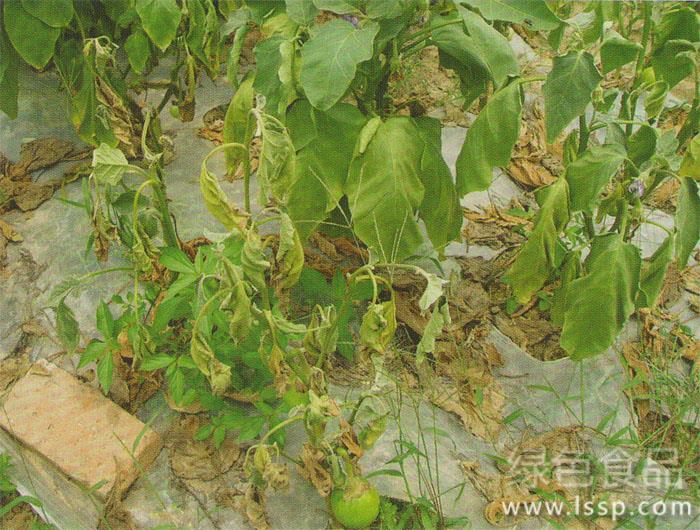
Eggplant Verticillium wilt
Eggplant Verticillium wilt is a fungal disease. The pathogen spreads through wind, rain, irrigation water, farming operations, etc. High temperature and high humidity worsen the disease. The growth temperature of the pathogen is 20-25°C. In addition, transplanting eggplant too early, carrying soil on the roots during transplanting, root damage, planting too deep, continuous cropping for no more than 3-4 years, use of undecomposed farmyard manure, and excessive use of nitrogen fertilizer can all cause the occurrence of this disease.
Prevention and control methods: First, use grafting for seedling cultivation. Second, rotate with non-solanaceous crops for more than 4 years. Third, increase the application of organic fertilizer and apply phosphorus and potassium fertilizer reasonably. Fourth, plant at a reasonable density. Fifth, water at the right time to improve the disease resistance of eggplant plants. Sixth, in the early stage of the disease, drench the roots with 500-fold carbendazim wettable powder or 800-fold thiophanate-methyl solution, applying 500 milliliters of solution per eggplant plant, about once every 7 days, for 3 consecutive drenchings. Diseased eggplant plants can be removed to avoid cross-infection. Also use metronidazole and carbendazim for spray control.