How to prevent and control eggplant rot in summer's high temperature and high humidity
In summer's high temperature and humidity, eggplants rot easily, and this is caused by Phytophthora fruit rot, brown spot disease, and gray mold.
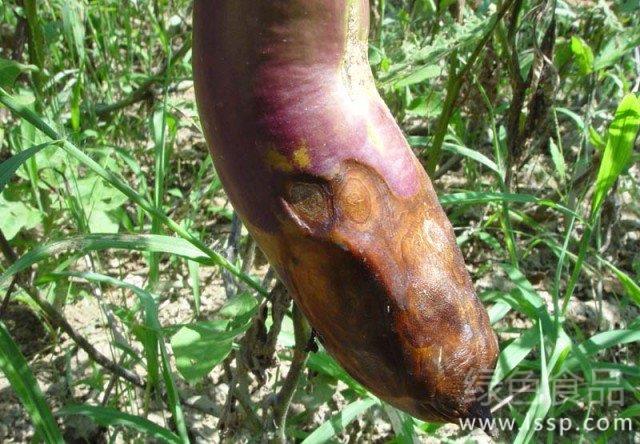
Eggplant rot disease
The so-called "dropping eggs" and "rotten eggplants" refer to Phytophthora fruit rot. After eggplants are infected by this disease, water-soaked round spots first appear, and later the eggplant flesh turns dark brown and rots, giving off a foul odor; when humidity is high, white mold grows on the diseased parts of the eggplant. To prevent and control this disease, cultivation management should be strengthened to avoid high temperature and humidity, such as reasonable pruning; after eggplant harvest, promptly remove old leaves and diseased leaves from the lower part of the eggplant plants; after heavy rain, promptly drain standing water and water with well water to lower the ground temperature and prevent humid hot gases from fumigating the eggplants, etc. At the same time, chemical control can be used by spraying 64% Sandofan WP 500 times dilution, or 72.2% Previcur AS 800 times dilution, etc. Alternate the chemicals to avoid developing resistance.
Eggplant brown spot disease: if the lesions on the eggplant are round or oval, sunken, and arranged in concentric rings, and the eggplant leaves have water-soaked round spots with pale centers and many concentric ring-like black dots, and the stems have diamond-shaped lesions with dark purplish-brown edges. When the disease is severe, the eggplant is covered with lesions that merge with one another, and in humid weather the diseased fruits rot easily, or shrink and dry into mummified fruits that do not drop off. To prevent and control this disease, first, promptly hoe and loosen the soil, prune and remove side shoots to increase ventilation and light penetration of the eggplant plants; second, apply more phosphorus and potassium fertilizer so the eggplants grow and develop early, moving the eggplant harvest period ahead of the disease epidemic; third, farming operations should be chosen on sunny days, avoiding pruning, tying vines, and harvesting on cloudy days; fourth, in the early stage of the disease, use 58% metalaxyl • mancozeb WP 400 times dilution, or 64% Sandofan WP 500 times dilution, 10% Score WG 1500 times dilution, or 80% Daconil WP 600 times dilution, spraying once every 7-10 days, for 3-4 consecutive sprays.
Eggplant gray mold: at the adult plant stage, leaves become diseased, spreading inward from the leaf edge in a "V" shape. The lesions are initially water-soaked with irregular edges, later becoming light brown to yellowish-brown. Diseased petals and flower cores fall onto the eggplant leaf surface or branch forks, forming round or spindle-shaped lesions. The lesions have faint concentric rings. After the diseased leaves dry up, under high humidity there is a grayish-brown mold layer. Eggplant disease mostly occurs during the fruiting stage, damaging the first fruit and the pair fruit, forming brown water-soaked lesions the size of a finger pad at the top of the young fruit or around the calyx. The diseased part is sunken and rotten, dark brown, with a black mold layer. When dipping eggplant flowers, 0.1% of 50% Sumilex WP can be added to the growth stimulant to prevent this disease; if the disease has already occurred, in the early stage spray 50% Sumilex WP 2000 times dilution; 50% Iprodione WP 1500 times dilution or 60% Fenaminosulf WP ultra-fine powder 600 times dilution spray. Remove diseased fruits, diseased leaves, and side branches, and burn them in a concentrated manner or bury them deeply.