Apricot gummosis causes wood rot and weakens the tree. What are the control methods?
Apricot gummosis mainly occurs on the trunk and main branches, with the trunk being more severely affected. In the early stage of the disease, the affected part swells and continuously exudes yellow gum, with gum flow becoming more severe after rain. When the gum contacts the air, it turns reddish-brown. 3~4 gum beads join together to form circular, irregular gummosis lesions 3-5mm in diameter, which are gelatinous and become reddish-brown hard gum blocks after drying. The affected parts of the apricot tree are easily infected by saprophytic fungi, and the cortex and xylem turn brown and rot, causing the apricot tree to weaken, with leaves turning yellow and becoming smaller, and in severe cases the tree dies.
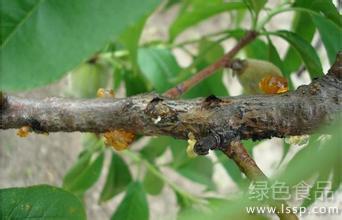
Apricot gummosis
Disease occurrence pattern:High humidity is an important condition for the occurrence of apricot gummosis. Wind and rain spread the pathogen, causing initial infection on branches and bark. Generally, on upright-growing apricot branches, the parts above the base are more severely affected; on lateral branches, the side facing the ground is more affected than the upward side; and the branch crotches are most severely affected. In addition, poor soil, insufficient fertilizer and water, heavy fruit load, and severe pest damage can all induce gummosis.
Control measures:
(1) Strengthen cultivation management: apply more organic fertilizer, prune reasonably, reduce wounds, strengthen tree vigor, and improve the disease resistance of apricot trees.
(2) Protect the tree body: whitewash the trunk in winter and spring to prevent freeze damage and sunscald. Strengthen pest control to reduce pest damage to apricot trees. During field operations, avoid causing wounds to reduce the incidence of disease.
(3) Clean the orchard: in winter, prune off diseased and dead apricot branches, gather and burn them to reduce sources of inoculum.
(4) Apply and spray chemicals: before bud break, scrape off the lesions and apply fungicide, using 50% Tuzet 800-fold solution or 50% carbendazim 500-fold solution to coat the lesions. Before bud break in early spring, spray 5-degree lime sulfur mixture to kill overwintering pathogens. In the early stage of the disease, use 5% Tuzet 800-fold solution or 50% carbendazim 800~1000-fold solution, or 50% thiophanate-methyl 1000~1500-fold solution, spraying once every 10 days for 3~4 consecutive sprays. During the peak period of the disease on apricot trees, spray 50% Tuzet 800-fold solution, 70% mancozeb 500-fold solution, or 80% anthracnose Fumei 800-fold solution, spraying once every 7-10 days for 3~4 consecutive sprays. The above pesticides should be used alternately.