How to prevent and control cucumber gummy stem blight that causes leaf shrinkage and spots
Cucumber gummy stem blight (stem rot) refers to the period when cucumbers have just set a large number of fruits: if high temperature and humidity occur, cucumber leaves wilt during the day and recover at night; after this repeats for several days, the leaves lose their function, and finally the leaves of the whole cucumber plant droop and cannot recover. As the disease progresses, the epidermis at the stem base splits lengthwise and brown gum oozes out. When humidity is high, white or pink mold-like growth appears; when the diseased stem is cut lengthwise, the vascular bundles can be seen browning. Within just a few days, the vines of an entire ridge and an entire plot of land will lose water and wilt, leaving obvious spots. This disease is a soil-borne disease; the pathogen of gummy stem blight can survive in the soil for 5-6 years. Continuous cropping land, clay land, low-lying land, poor drainage and extensive management can all lead to cucumber gummy stem blight.
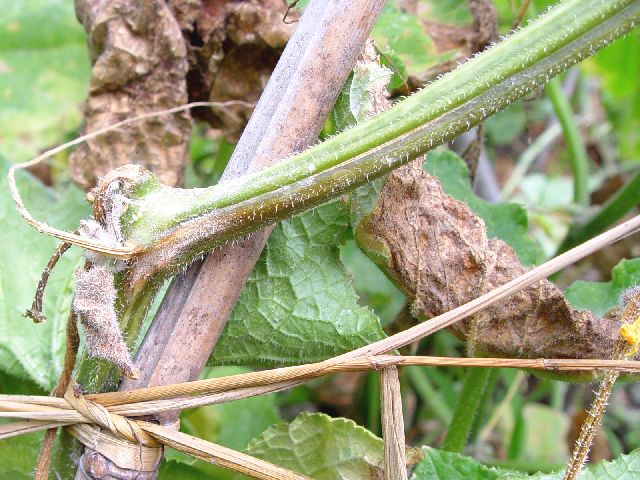
Cucumber gummy stem blight
Symptom identification: Cucumber leaves and stems can both be infected. After the leaves are damaged, nearly round or irregular spots form; some spots spread inward from the leaf margin in a “V” shape or semicircular shape, light brown to yellow-brown; in the later stage the spots easily break apart, and dense small black dots grow on the spots. These small black dots are the pathogen's pycnidia. The spot diameter is about 10-35 mm, and a few spots are even larger. Diseased leaves turn yellow and wither from top to bottom but do not fall off; when the disease is severe, only the upper 1-2 leaves remain symptomless. When petioles, vines and the stem base are damaged, the spots are oil-soaked in appearance, round to diamond-shaped, yellow-brown, and sometimes amber resinous matter oozes out. When the disease is severe, the stem nodes turn black and rot, break off, and the diseased parts often crack; after drying they become yellow-brown to red-brown. Small black grains are scattered on the surface.
Transmission routes and disease conditions: Cucumber gummy stem blight is a fungal disease. It overwinters with diseased cucumber plant residues left in the soil, on seeds and on greenhouse frames, and spreads through wind, rain and irrigation water. The pathogen invades cucumber plants through stomata, water pores and wounds. Seed-borne bacteria cause leaf infection. The optimum temperature for gummy stem blight is 18-25°C, and the humidity is above 85%, especially on consecutive cloudy days when nighttime dew is heavy; flood irrigation and high soil moisture are suitable for the occurrence of cucumber gummy stem blight. In addition, continuous cropping land, flat-bed cultivation, poor drainage, excessive density, insufficient fertilizer, and plots where cucumber plants grow weakly are all prone to the disease.
Prevention and control methods:
1. Select disease-free cucumber seeds and disinfect the seeds. Select disease-free fields and disease-free cucumber plants as seed-producing plants. If cucumber seeds are suspected of being infected, soak them in 55°C warm water for 15 minutes, or soak them in a 40% methanol solution for 30 minutes, then wash them clean and sow.
2. Implement 2-3 years of crop rotation, apply formula fertilization, and strengthen fertilizer and water management. Apply sufficient base fertilizer and increase the application of phosphorus and potassium fertilizers. The use of biological fertilizers, active organic fertilizers and inorganic compound fertilizers must be reasonable. During the cucumber growth period, topdress multiple times to prevent premature aging and enhance disease resistance. When watering, avoid flood irrigation; cultivate the soil promptly after watering; after the disease occurs, appropriately control watering to reduce soil and air humidity. And ventilate promptly to reduce humidity. When diseased plants are found, pull them out promptly.
3. Disinfect the greenhouse. Before cucumber planting, the greenhouse needs to be disinfected; 300 ml of formalin mixed with an equal amount of water and heated can fumigate a 37 cubic meter greenhouse. Fumigate for 6 hours each time.
4. Chemical control. In the early stage of the disease, spray the whole greenhouse; you can choose 75% chlorothalonil wettable powder 600 times solution, or 65% zineb powder 500-700 times solution, or 50% thiophanate wettable powder 500 times solution, or 50% carbendazim wettable powder 500 times solution, spraying once every 5-7 days. You can also use 50% carbendazim wettable powder 500 times solution to drench the roots 1-2 times. If the stem is infected, you can mix carbendazim or chlorothalonil with water into a paste and apply it to the diseased parts of the cucumber.