How to prevent and control anthracnose when ginger leaves develop black spots and droop
Ginger anthracnose damages leaves, leaf sheaths and stems. Infected leaves mostly begin to show nearly round or irregular water-soaked chlorotic lesions from the leaf tip or leaf margin, which connect with each other to form irregular large patches. In severe cases, the leaves dry up; when humid, slightly rough small black grains grow on the lesions. In severe cases, ginger leaves droop but still remain green.
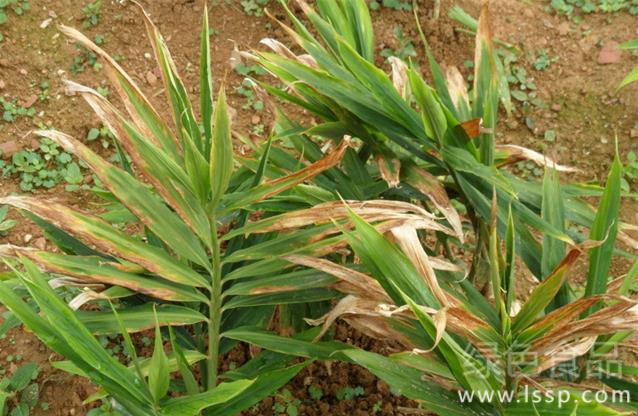
Ginger anthracnose
Pathogen: The pathogen of ginger anthracnose is Colletotrichum capsici, a fungus belonging to the Fungi Imperfecti. The acervuli form beneath the host epidermis, then break through the epidermis and appear disc-shaped. Dark brown setae grow on the acervuli, with 2-4 transverse septa; the conidia are crescent-shaped, colorless, single-celled, measuring 20-31×3-6 microns. The small black grains seen on the diseased parts are the acervuli and conidia of the asexual generation of the pathogen.
Occurrence pattern: The pathogen overwinters as mycelium or acervuli latent in ginger seed rhizomes, or overwinters in the soil with diseased residues. Sowing infected ginger seed rhizomes can cause ginger seedlings to develop the disease. After overwintering, the mycelium spreads through rain and wind splashing, insects or irrigation water. When conditions are suitable, it grows germ tubes and invades through wounds in the ginger epidermis. After the initial infection, a large number of conidia are produced again, and after spreading, repeated reinfection occurs frequently.
Disease conditions: High temperature and high humidity favor the occurrence of ginger anthracnose. For example, when the average temperature is 26-28°C and the relative humidity is greater than 95%, the disease can develop 3 days after the pathogen invades. Low-lying terrain, heavy clay soil, poor drainage, overly dense planting with poor air permeability, insufficient fertilization or excessive nitrogen fertilizer, extensive management causing epidermal wounds, or situations such as many fallen leaves due to leaf spot disease and fruit exposed to scorching sun, are all likely to induce this disease.
Control methods: To control ginger anthracnose, cultivation-based disease control should be strengthened, combined with spray protection.
1) Reduce pathogen sources. Thoroughly clean the field, do not apply farmyard manure mixed with piled diseased ginger residues that has not completely decomposed, and deep-plow and sun-dry the soil to reduce the sources of initial infection.
2) Crop rotation: Do not carry out continuous cropping or adjacent cropping with Solanaceae or other Zingiberaceae crops. Rotation with gramineous crops can be used.
3) Plant on high ridges with deep furrows, apply high-quality organic base fertilizer, level the ridge surface, carry out timely intertillage and hilling, remove weeds, reduce field humidity, and increase the application of phosphorus and potassium fertilizer.
4) Spray protection: In the early stage of ginger anthracnose, you can choose to spray 80% carbendazim-thiram wettable powder 600-750 times dilution, 20% prochloraz emulsifiable concentrate 1000 times dilution, 40% carbendazim • sulfur suspension concentrate, 50% carbendazim wettable powder 800 times dilution, 50% thiophanate-methyl wettable powder 500 times dilution + 75% chlorothalonil wettable powder 1000 times dilution, 50% prochloraz wettable powder 1000 times dilution, 77% copper hydroxide wettable micronized powder 800 times dilution, etc., once every 8-10 days, spraying continuously 3-4 times.