Causes of Pepper Plants Dying in Summer and Methods for Preventing and Treating Damping-Off
Pepper Fusarium wilt manifests as slow plant growth during the flowering and fruiting stage, with lower leaves turning yellow and gradually progressing upward. At noon the leaves wilt, recover at night, and after this repeats for several days, the whole plant wilts and dies. Sometimes half the plant is affected while the other half remains healthy; when the disease is severe, the entire plant wilts. The epidermis at the stem base of the pepper plant is mostly longitudinally split, with yellow-brown streaks on the nodes and internodes, exuding a rosin-like gummy substance. When humid, white and pink mold layers grow. The vascular bundles and roots of the pepper turn yellow-brown, rot, and are very easily pulled from the soil. A cross-section of the diseased stem shows the vascular bundles are brown.
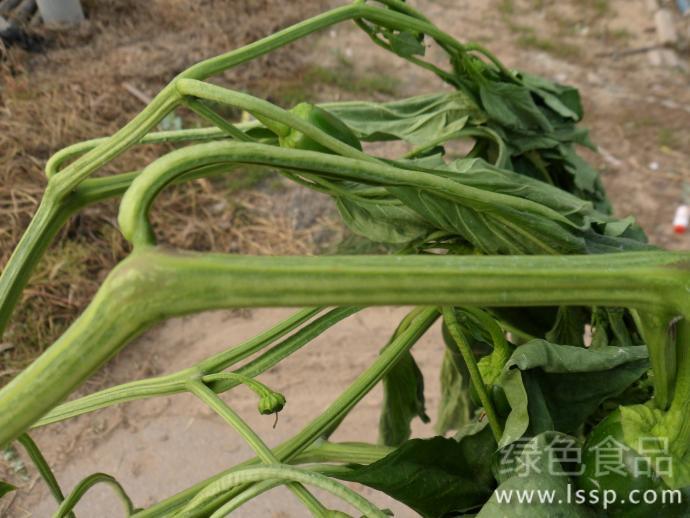
Pepper Damping-Off
During the onset of pepper root rot, water-soaked lesions appear on the stem near the ground, slightly sunken, then rotting, and the main and lateral roots decay and die.
Pepper stem base rot starts from large seedlings and becomes more severe after transplanting. Lesions appear at the stem base of the pepper near the ground, initially dark brown, then developing around the stem base, causing the cortex to rot and the aboveground leaves to turn yellow. During the pepper swelling stage, the plant gradually wilts and dies due to insufficient nutrient and water supply. External causes: soil that is excessively wet, plant density that is too high, poor ventilation; in the soil, due to continuous cropping, excessive accumulation of pathogens, and excessively high soil temperature, etc. Human factors: at transplanting, the pepper seedlings are increasingly older, and with the overly large aboveground part, people do not pay attention during transplanting, the pepper plants shake severely, and the stem base is prone to wounds. In addition, management practices such as covering with plastic film, trellising, and training the vines cause even more wounds.
The above three diseases are transmitted by fungi. The pathogens can survive in the soil for many years, and the diseases occur severely under continuous cropping.
1. Implement crop rotation: rotate peppers with non-solanaceous crops for more than 3-5 years. The seedbed should be relocated every 2-3 years, or replaced with new soil.
2. Improve the soil and apply a no-deep-tillage soil conditioner: in severely diseased or continuously cropped land, while preparing the land, apply 1200-1500 kg of slaked lime powder per hectare to inhibit pathogen development. Applying a no-deep-tillage soil conditioner also loosens and aerates the deep soil; through rain or watering, the pathogen concentration in the upper soil layer is reduced, alleviating the disease.
3. Before raising seedlings and sprouting pepper seeds, they should be disinfected. Common methods: hot water seed soaking; dry heat treatment, placing dry pepper seeds at a constant temperature of 70-75°C for 5-7 days.
4. Cultivation management: choose high, dry fields for cultivating peppers, and use ridge planting, high beds, or semi-high beds for planting; control the amount of watering, drain promptly during the rainy season, and prevent waterlogging damage; when fertilizing, pay attention to the combined application of nitrogen, phosphorus, and potassium to prevent nutrient deficiency or excessive nitrogen. At transplanting, remove diseased seedlings to reduce the disease incidence. At transplanting, use younger pepper seedlings to reduce mechanical damage. During transplanting, covering with plastic film, trellising, and other processes, handle gently and set down gently, and try to avoid injuring the pepper seedlings. After transplanting, at the early stage of disease, apply a seed-dressing dual-agent soil at the stem base of the pepper. To reduce wounds, try not to hill up soil during the growing period.
5. Chemical control: at the early stage of disease, you can use 50% carbendazim wettable powder at 500 times dilution; or 50% thiophanate-methyl at 400 times dilution; or 10% shuangxiaoling ii aqueous solution at 200-300 times dilution; or agricultural antibiotic 120 at 100 times dilution; or 48% ruikumai aqueous solution at 800 times dilution, pouring 0.25 kg of the solution at the root of each pepper plant, once every 10 days, for 2-3 consecutive times.