Good management during the flowering and fruiting period of lotus seeds makes the mature lotus seeds attractive and delicious
In July, lotus seeds have entered the flowering and fruiting period, and sufficient sunlight is beneficial to the growth and development of lotus seeds. The key management points during the flowering and fruiting period of lotus seeds are as follows:
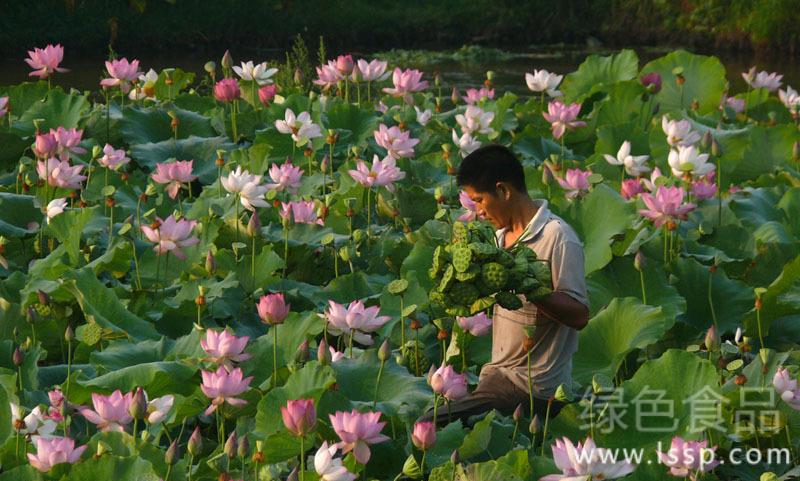
Lotus seed harvesting
1. Water. Lotus seeds have strong adaptability to water. The flower bud stage of lotus seeds is in midsummer, so the water layer can appropriately be raised to 15-18cm to meet the needs of cooling and evaporation in the lotus field.
2. Remove sterile lotus plants. In continuously cropped lotus fields, the underground stem density is high, so more attention should be paid to removing sterile lotus plants. Sterile lotus plants consume nutrients and affect the growth and development of other flower buds of lotus seeds. When removing sterile lotus plants, pick the leaves but do not break the stems, to prevent rainwater from entering the lotus stems and causing underground stem rot. Remove sterile lotus plants until the middle stage of lotus seed harvesting.
3. Scientific fertilization. For each mu of lotus field, use 20-30 kg of imported compound fertilizer or 15 kg of urea plus 15 kg of potassium chloride or 30-40 kg of rapeseed cake and add 1 kg of borax, mix well, and after the dew in the lotus field has dried, broadcast it over the whole field. Never scatter fertilizer onto the leaves and flower buds to avoid damage.
4. Disease and pest control. The main diseases of lotus seeds: rot disease, leaf blight, leaf wilt, etc. Pests include aphids, lotus armyworms, etc.
Rot disease occurs between June and July. In affected lotus seeds, the base of the lotus rhizome and stem and the rhizome nodes turn brown and rot, lose water and dry up, and the whole plant dies.
Lotus leaf blight: it damages the leaves. The lotus leaves become covered with light yellow spots, which spread from the leaf edges to the veins, and then the whole leaf dies.
Fusarium wilt: lotus leaves begin to wilt while still green, the edges curl upward, the whole plant dies, and the flower buds also die.
Aphids: they damage the young leaves and tender stems of lotus seeds and slow the growth rate of lotus leaves; lotus armyworms damage lotus leaves and eat entire lotus leaves.
Control measures: select strong seedlings free of pathogens, disinfect seedlings, and fertilize scientifically. In the early stage of disease, pull out diseased plants. Chemical control: choose 200 g of 70% thiophanate-methyl mixed with 30 kg of fine soil, pile and cover for 2-3 hours, then broadcast after draining the lotus field, or spray with Green Enjoy No. 1 or 20% Bordeaux suspension concentrate at 1000 times dilution, for 2-3 consecutive treatments. For pest control, 80% dichlorvos at 800 times dilution or pyrethroid at 1500 times dilution can be used.
5. Timely harvesting. Begin harvesting lotus seeds in early July. When the lotus seedpod turns green-brown and the surface of the lotus seeds is tea-brown, they can be harvested. Lotus seeds that are too old or too tender are not suitable for processing and affect the quality of lotus seeds.