Eggplant Bacterial Wilt Causes Plant Stunting: How to Prevent and Control It
When eggplant is affected, initially individual leaves or parts of leaves wilt and droop, then it gradually spreads to the branches of the entire eggplant plant. At first they turn pale green, then become brown and scorched; the diseased leaves remain on the branches or drop off. When the stem cortex is peeled open, the xylem is brown. This discoloration can extend from the root crown up to the xylem of the upper branches. In the branches of infected eggplant, the pith is mostly rotted and hollow. When squeezed by hand, a milky white mucus oozes out.
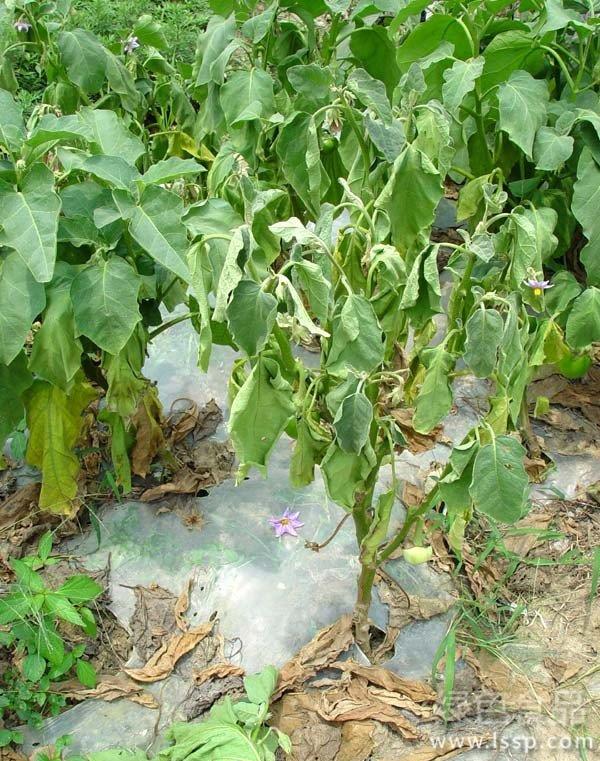
Eggplant Bacterial Wilt
Occurrence pattern:
Eggplant bacterial wilt is a disease caused by bacteria. The pathogen overwinters on the diseased plant residues left in the soil, invades through wounds on the eggplant roots or stem base, and spreads through rainwater, irrigation water, farm tools, livestock, and so on. A hot and humid environment favors the occurrence of eggplant bacterial wilt. When it turns clear after rain and the temperature rises, the disease occurs severely. Continuous cropping and slightly acidic soil result in severe disease.
Control measures:
(1) Rotation with scallions and garlic.
(2) Select eggplant varieties resistant to bacterial wilt.
(3) Grafting to prevent disease.
(4) Choose disease-free soil for raising seedlings, apply an additional 50-100 kg of lime per mu to the planting plot, adjust the soil to be slightly alkaline, use high-ridge cultivation, ensure field drainage, and avoid flood irrigation. Apply sufficient base fertilizer, and apply nitrogen and potassium fertilizer as topdressing during the growing period. In the middle and late growth stages, stop intertillage to prevent root injury. After harvest, promptly remove the diseased and residual eggplant plants and burn them in a centralized manner.
(5) At the early stage of disease onset, immediately pull out the diseased plants, and drench the diseased holes with 2% formaldehyde solution, or disinfect with 20% limewater. Drench the whole field with 800x dilution of “Tianda 2116” + 1000x dilution of “Tianda Nuosha”, 4000x dilution of 72% agricultural streptomycin soluble powder, 600x dilution of 77% Duoning wettable powder, 500x dilution of 77% Keshade wettable powder, and 400x dilution of 50% copper bis(diammonium diacetate) (DT) wettable powder, applying 0.3 L per eggplant plant, once every 10 days, for 2-3 consecutive drenchings.