What are the commonly used fungicides and preservatives for bananas?
Which fungicides and preservatives can be used for bananas? Please give an introduction. The following products can be used as banana fungicides and preservatives: (1) Chlorothalonil is a broad-spectrum fungicide with good preventive action against fungal diseases in many crops, but it has no systemic translocation action, so once the crop has been invaded by pathogens and they have entered the plant body...
Which fungicides and preservatives can be used for bananas? Please give an introduction.
The following products can be used as banana fungicides and preservatives:
(1) Chlorothalonil is a broad-spectrum fungicide with good preventive action against fungal diseases in many crops, but it has no systemic translocation action, so once the crop has been invaded by pathogens and they have entered the plant body, it has no curative ability. For the prevention of banana black spot and various leaf spot diseases, a 75% chlorothalonil wettable powder is commonly sprayed as an 800-1000 times dilution, with a protection period of 7-10 days.
(2) Tilt, also known as propiconazole, is a systemic fungicide with both protective and curative action. It can be absorbed by roots, stems and leaves, and can quickly conduct upward within the plant. It is mainly used for the control of various fungal diseases. For the control of banana black spot and leaf spot diseases, a 25% Tilt emulsifiable concentrate is commonly sprayed as a 1000-1500 times dilution, with an application interval of 21-28 days.
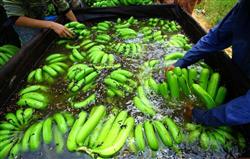
(3) Rovral, also known as iprodione, is a highly effective, low-toxicity, low-residue, broad-spectrum contact fungicide. It has good fungicidal effect against many fungi and can be used on many crops to prevent various diseases. It is also commonly used for the storage and preservation treatment of fruits and vegetables. Soaking fruit for 1 minute in a 1600-2500 times dilution of 50% Rovral wettable powder has a good effect on controlling banana crown rot during storage and transport.
(4) Imazalil, also known as imazalil, is a broad-spectrum fungicide commonly used to control storage diseases of fruits and vegetables, and is especially more effective against fungi that have developed resistance to thiabendazole and carbendazim. Soaking fruit for 1-2 minutes in a 500 times dilution of 50% imazalil emulsion has a good effect on controlling banana anthracnose during storage and transport.
(5) Ethoprophos, also known as ethoprophos and Mocap, is a nematicide and insecticide with contact action. It can control many pathogenic nematodes and also has good control effects on many soil-dwelling pests. It can be applied before sowing, before transplanting, or during the growing period of the crop. Applying 30 g of 20% Mocap granules per plant by broadcasting around the banana mat (with the stem as the center, within a radius of 0.75 m) and then covering with soil can control various banana nematode diseases.
(6) Fenamiphos, also known as fenamiphos and Nemacur, is a nematicide and insecticide with contact and systemic action. After being absorbed by the root system, the agent can be transported toward the top, so it can kill insects with piercing-sucking mouthparts such as aphids and thrips. This agent can control many nematodes on many crops. The dose for controlling banana nematodes is 30-40 g of 10% Nemacur granules per plant, with a residual effect lasting up to 3 months. In addition to referring to ethoprophos for the application method, because of its excellent water solubility, it can also be applied by drenching with water.
(7) Potassium permanganate is not only a commonly used disinfectant, but in the preservation and rot prevention of fruits and vegetables it also serves as an ethylene absorbent to absorb the ethylene released by fruits and vegetables, which can significantly delay the post-ripening period of the product and extend the storage and preservation period. Generally, diatomite, vermiculite or foam brick that has fully adsorbed a saturated potassium permanganate solution is placed in a breathable inner packaging bag, and then placed in a carton or film bag loaded with bananas for storage and transport. The preservation effect is obvious, and if it can be combined with anti-rot fungicides, the effect is even better.
(8) High-fat film water emulsion is a white, non-toxic emulsion made from higher fatty alcohols or higher fatty acid substances through certain processing. After being diluted with water and sprayed on or soaked into crops, it forms a very thin, invisible high-fat film layer on the plant surface that wraps the plant, playing a role in regulating plant physiological activities and blocking the spread of pathogens, thereby achieving the goals of drought resistance, cold resistance, disease control, rot prevention and preservation, and increased yield. It has been widely used in fruit trees, vegetables, Chinese herbal medicines, crop production, and storage and preservation. For spraying crops, generally dilute each 1 kg with 100-150 kg of water and soak for 1 minute. For other agents, please refer to the relevant section on mango.
(9) 24% INDAR suspension concentrate is a systemic conductive curative fungicide. It can control the elongation of pathogen hyphae, prevent germinated pathogen spores from invading crop tissues, and when applied during the latent period of the pathogen, it can prevent the development of the pathogen; when applied after disease onset, it can cause the next generation of spores to deform and be unable to continue infecting. It has low toxicity to humans and livestock and does not harm beneficial organisms, animals, or insects. The liquid penetrates into the plant body within a few hours after spraying. Except for strongly acidic and strongly alkaline pesticides, it can be mixed with most insecticides and fungicides. The dosage is a 1500-2000 times dilution.
(10) Kocide 2000 is a newer copper-based fungicide that can control the main fungal and bacterial diseases of many crops. It is effective at dilutions above 1000 times, has no residue, is pollution-free, has extremely strong adhesion, and has long-lasting efficacy. The dosage is a 1000-1200 times dilution.
(11) SPORGON 50% wettable powder is an imidazole broad-spectrum fungicide. It strongly inhibits sterol biosynthesis in the fungal cell wall and has both protective and eradicant efficacy. It has no systemic action but has osmotic conductive action. It is suitable for postharvest preservation of fruit and has a preventive effect on anthracnose. The dosage is a 1000-2000 times dilution.
Click to get more fungicide application techniques
Click to get more pesticide application techniques