Control methods for celery leaf spot disease causing leaf rot
Celery leaf spot disease, also known as early blight. When plants are affected, the disease first appears at leaf edges and petioles, then gradually spreads to the entire leaf. Affected leaves initially show water-soaked yellow-green spots, which later become round or irregular, with lesion sizes of 2-15 mm, grayish-brown, with slightly darker edges, yellowish and relatively thin inside, not restricted by leaf veins. In severe cases, the lesions enlarge and merge into patches, causing celery leaves to turn yellow and die. When celery stems or petioles are affected, the lesions are oval, with lesion sizes of 3-23 mm, initially yellow, slowly turning grayish-brown and sunken, with the stem splitting open. In severe cases, the stem constricts and lodges, and rots under high humidity.
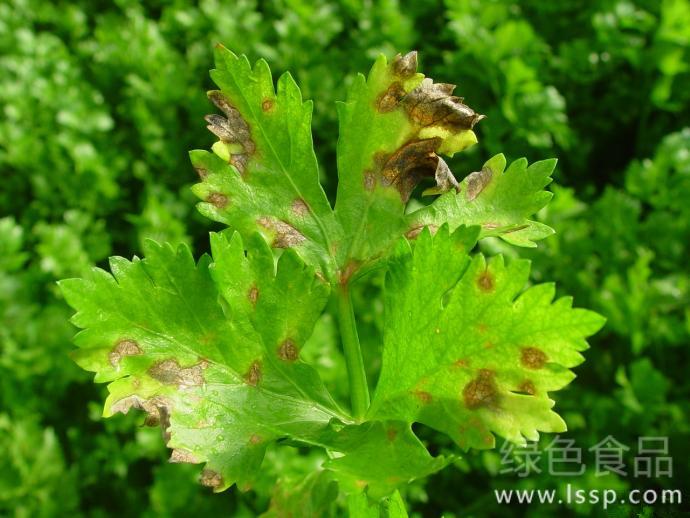
Celery leaf spot disease
Disease conditions:The optimum temperature for the onset of celery leaf spot disease is 22-30°C, with relative humidity above 85%. The optimum temperature for conidia formation is 15-25°C, and the optimum temperature for germination is 28°C. High temperature and rainy conditions, and low-lying areas, are prone to the disease, but under conditions of high temperature, drought and nighttime dew formation, it is also prone to occur. In addition, insufficient fertilizer, excessive irrigation, or weak celery plants result in severe disease.
Disease pattern:Celery leaf spot disease can occur at the seedling stage and the adult plant stage, with adult plants being more severely affected, mainly damaging stems and leaves. In the Lanzhou area, celery leaf spot disease mainly affects the next crop, with July—September being the peak period.
Integrated control techniques:
1. Select disease-resistant varieties: Celery varieties such as Gaoyouta, California King, Ventura, Baili Celeriac, and Nencui have relatively strong disease resistance.
2. Seed treatment:
(1) Hot water seed soaking. Place the seeds in 50°C warm water and stir constantly so that the seeds are heated evenly. After soaking for 25 minutes, immediately put them into cool water to dissipate the heat.
(2) Chemical seed soaking. Before sowing, use chemical agents to kill or inhibit pathogens on the surface of celery seeds and those latent inside the seed coat. Celery seeds can be soaked in a 600-fold dilution of 50% thiram wettable powder for 50 minutes, then washed clean with water, air-dried, and sown directly.
3. Clean the field: In the early stage of disease onset, promptly remove diseased leaves and basal leaves; after harvest, remove celery diseased residues, concentrate them for destruction and deep burial, and combine with deep plowing to reduce sources of infection. Crop rotation of more than 2 years can reduce the amount of inoculum.
4. Cultivate strong seedlings. Keep the seedling house (bed) isolated from the production area. Before raising seedlings, thoroughly remove celery diseased residues and disinfect the soil. Choose cloudy days or evening for sowing to avoid high temperatures. Before sowing, first water thoroughly to saturate the bottom soil, then fill low-lying areas with fine soil to prevent uneven emergence or weak celery plants, and cultivate disease-free strong seedlings.
Celery leaf spot disease
5. Rational fertilization: Celery has a relatively shallow root system. After the previous crop is harvested, broadcast 3000 kg of decomposed barnyard manure per mu of celery, or apply 1000 kg of decomposed human manure and urine, and combine with deep plowing, leveling and bed preparation, to provide relatively good conditions for celery plant growth and enhance celery disease resistance.
6. Field management: After celery is transplanted and the seedlings have revived, apply fertilizer and water together to promote plant growth. For winter and spring production, the day-night temperature difference is large, and the nighttime dew formation period is long, making the disease prone to occur. Attention should be paid to keeping warm and preventing cold, reducing the day-night temperature difference, and preventing dew formation. In summer and autumn, with high temperature and rain, attention should be paid to drainage, and small amounts of water should be used for irrigation to prevent water accumulation in the beds. In protected cultivation, ventilation should be strengthened to reduce humidity.
7. Spray control: In the early stage of disease onset, spray 50% thiophanate-methyl wettable powder at 500-fold dilution, or 40% sulfur-carbendazim suspension concentrate at 800-fold dilution, or 77% copper hydroxide wettable powder at 500-fold dilution, or 50% kasugamycin-copper wettable powder at 400-500-fold dilution, once every 7-10 days, for 2-3 consecutive times. Under protected cultivation conditions, 5% chlorothalonil dust can be used, with 1 kg per mu of celery each time, once every 9 to 11 days. Or apply 45% chlorothalonil smoke agent, with 200-250 g per mu of celery, about once every 9 days, for 2-3 consecutive or alternating times.