August management key points for newly planted grapes: proper management brings higher yields
For newly planted grapes, by August the vines have developed from the growth stage to the bud formation stage. During this period, strengthening the prevention and control of grape downy mildew and increasing the application of phosphorus and potassium fertilizers are especially critical for raising grape yields. If the prevention of downy mildew and the application of phosphorus and potassium fertilizers are neglected, large-scale disease outbreaks will occur, causing grape leaves to lose photosynthesis and metabolic function; insufficient phosphorus and potassium fertilizers affect the maturation of new grape shoots and flower bud differentiation. For this reason, the following August management key points for newly planted grapes are proposed based on the growth characteristics of grapes, for reference only.
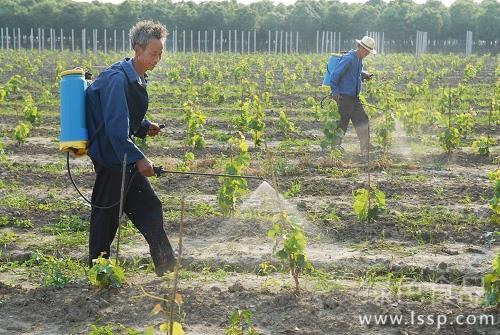
Grape management
1. Prevention and control of downy mildew:
Grape downy mildew is a common and frequently occurring disease, with a relatively high incidence especially in weather with high rainfall, high humidity and high temperatures. During the first year of grape planting, downy mildew is the most harmful to young vines. Control methods:
(1) Strengthen orchard management. In late autumn, collect diseased leaves and prune off diseased shoots, then burn or bury them deeply. Pay attention to drainage, pruning and bud removal; for trellises, raise the fruiting position to above 60cm, and prune off unnecessary canes and branches that are too close to the ground as much as possible, so as to reduce ground humidity and lessen disease occurrence. Vigorously growing grape varieties should use pergolas, or adopt “high, wide, drooping” training to moderate cane vigor and improve ventilation and light conditions.
(2) Spray for control. Use 50% ridomil wettable powder at 750 times dilution, spraying once every 20-30 days; or 40% meiyijing wettable powder at 300 times dilution, spraying once about every 15 days, which has an excellent effect on controlling grape downy mildew. In addition, Bordeaux mixture also has a good effect on controlling downy mildew. Bordeaux mixture can also be used for protection in the early stage; in addition, spraying 50% zineb wettable powder at 400—500 times dilution, or 64% sandofan wettable powder at 500 times dilution, or 58% ridomil MZ wettable powder at 500 times dilution all have good effects.
2. Increase the application of phosphorus and potassium fertilizers
After August, control nitrogen fertilizer and increase the application of phosphorus and potassium fertilizers to promote the maturation of branches and leaves, improve the disease resistance of grapes, and lay the foundation for production in the second year. In addition to topdressing and fertilizing, foliar topdressing should also be used to supplement various nutrients.