Post-harvest water and fertilizer management of grapes directly affects next year's yield
1. Prevent diseases and control pests to protect autumn leaves. First, care should be taken to minimize damage to the leaves during grape harvest. In addition, under normal circumstances, management measures involving the removal of old grape leaves should be used as little as possible or not at all, and in the late growth stage the use of thiram and sulfur-based pesticides should be strictly controlled to prevent premature aging of grape leaves and a reduction in photosynthetic efficiency. After harvest, the main pests and diseases are downy mildew, powdery mildew, leafhoppers, etc. Spraying 3000-fold fosetyl-aluminum or 1000-fold ridomil once every 10 days can effectively prevent downy mildew and powdery mildew.
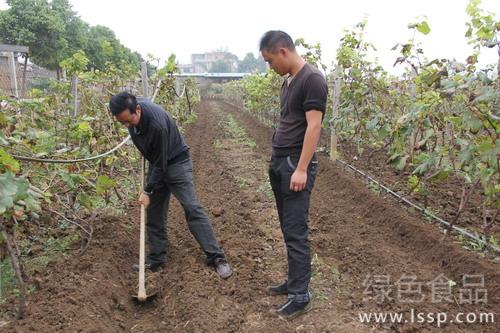
Fertilizing grapes
2. Fertilize rationally to restore tree vigor. Once grape harvest is complete, apply sufficient post-harvest fertilizer early and well; combined with pesticide spraying, spray 0.3% urea or 0.3% monopotassium phosphate solution 2-3 times, which can effectively improve leaf photosynthetic efficiency, restore tree vigor, and increase tree nutrition. When the fruit load is heavy and the tree vigor is rather weak, some quick-acting nitrogen fertilizer can be added, such as decomposed human excrement and urine, pig manure water, urea, etc. Base fertilizer is the most important part of fertilization in a vineyard. Production practice shows that the earlier the base fertilizer is applied in autumn, the better. Under normal circumstances, use 3000-5000 kg per mu of fully decomposed farmyard manure, barnyard manure, or compost, add 20 kg of superphosphate, mix them, and apply in trenches; after application, cover with soil and water thoroughly.
3. Pinch the tips and remove shoots to prevent excessive growth. Excessive growth of branches and vines will consume a large amount of nutrients from the tree, so measures such as pinching the tips and removing lateral shoots should be taken to control their growth, reduce ineffective nutrient consumption, and promote thick and strong main vines and retained lateral shoots with plump and full buds. Spraying 0.05% daminozide solution can also be used to inhibit vigorous growth. At the same time, branches and vines should also be pruned reasonably: retain more thick branches and fewer thin and weak branches, and remove overly dense branches, slender weak branches, and diseased and pest-damaged branches as early as possible.
4. Cultivate and loosen the soil and clean the orchard. Because operations such as picking and management are frequent, the soil is easily compacted. Immediately after harvest, carry out one cultivation and loosening of the soil to increase soil looseness and aeration and promote new root growth. Also, in combination with autumn and winter pruning, thoroughly remove dead branches, fallen leaves, and diseased and pest-damaged mummified fruit from the vineyard and destroy them in a centralized manner, reducing the overwintering base of pests and diseases and lessening their harm the following year.
5. Reduce damage and prevent forced winter buds. In some places, after grape harvest, large numbers of lateral shoots and old leaves are pruned off, which affects the maturity of the current year's branches and easily forces out winter buds, seriously affecting the growth and fruiting of the plants the following year. Generally, after harvest, do not remove leaves and remove as few shoots as possible, retaining healthy branches and leaves as much as possible. At the same time, pay attention during field operations to prevent mechanical damage to branches and leaves and ensure normal maturation of the branches and vines.