How to prevent and control chive blight that causes the whole field to wither and die?
Chive blight is a fungal disease caused by infection with Phytophthora nicotianae. Once the disease occurs, it develops rapidly and spreads quickly, destroying the entire field in a short time and causing losses.
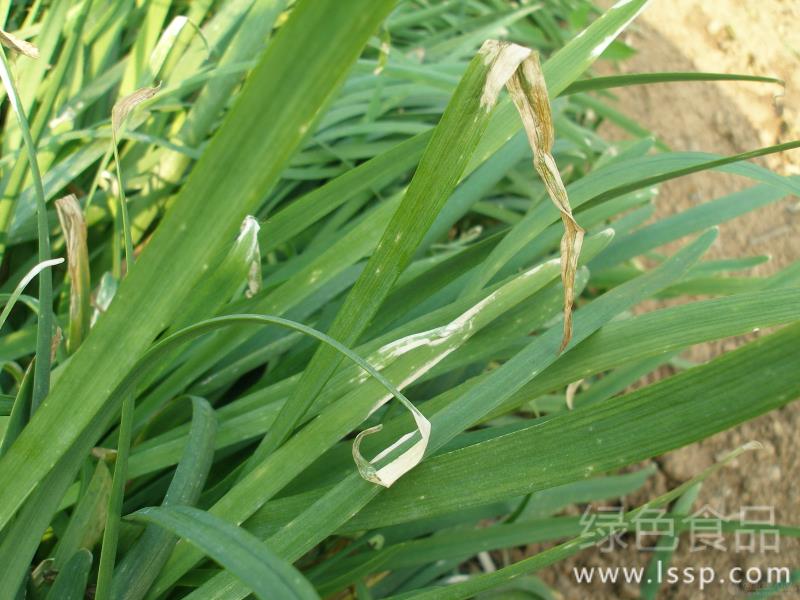
Chive blight
The entire chive plant can be affected, with the false stem and bulb suffering the most severe damage. When leaves are affected, dark green water-soaked lesions first appear; the lesions expand rapidly, the affected parts lose water, become constricted and thin, the leaves turn yellow, wilt and droop, leading to soft rot and detachment of the leaf sheath. When humidity is high, a sparse white mold layer grows on the affected parts. When the bulb is affected, the stem disc first becomes water-soaked, then turns light brown and dark brown, and soon rots. When the roots are affected, they rot and turn brown, root hairs decrease, and the chives stop growing and die.
Chive blight is spread by the pathogen's sporangia through wind and rain, irrigation water, and dripping water from greenhouse film, causing secondary infection. The optimum temperature for the disease is 25-32°C, and the relative humidity is above 90%. Chives are severely affected when there are water droplets on the greenhouse film. During the root-nourishing period in open fields, the disease is severe when there is abundant rain or heavy rainfall.
Prevention and control methods:
1. Agricultural control. When building greenhouses, choose drip-free film with strong tensile strength and good light transmission. During the root-nourishing period in open fields, drain standing water promptly after rainfall and ventilate to disperse moisture. Do not apply excessive nitrogen fertilizer, and do not plant chives too densely, so as to avoid tender, delicate chives with poor disease resistance. When watering, use small amounts of water and water carefully, strictly avoiding flood irrigation. Ventilate promptly to reduce humidity.
2. Chemical control. In the early stage of the disease, spray promptly. The following agents can be used: 25% metalaxyl wettable powder at 750 times dilution, or 58% metalaxyl mancozeb wettable powder at 500 times dilution, or 64% oxadixyl wettable powder at 400 times dilution, or 77% copper hydroxide wettable powder at 500 times dilution, or 80% mancozeb wettable powder at 600 times dilution, or 72.2% propamocarb aqueous solution at 800-1000 times dilution, or 90% phosethyl-Al wettable powder at 700 times dilution. Apply once every 7 days, spraying 2-3 times consecutively. You can also use copper sulfate at 500-1000 times dilution, or 25% metalaxyl wettable powder at 1000 times dilution to drench the chive roots.