Black spots appear on cabbage after it is infected with black rot, how to prevent and control it
Black rot seriously harms cabbage. The disease can occur from the cabbage seedling stage to the head-forming stage. After damaging the leaves and curds, it makes the cabbage lose its commercial value, causing reduced yield and losses. Therefore, cabbage black rot must be prevented and controlled promptly, achieving early treatment, treatment while the problem is small, and complete control.
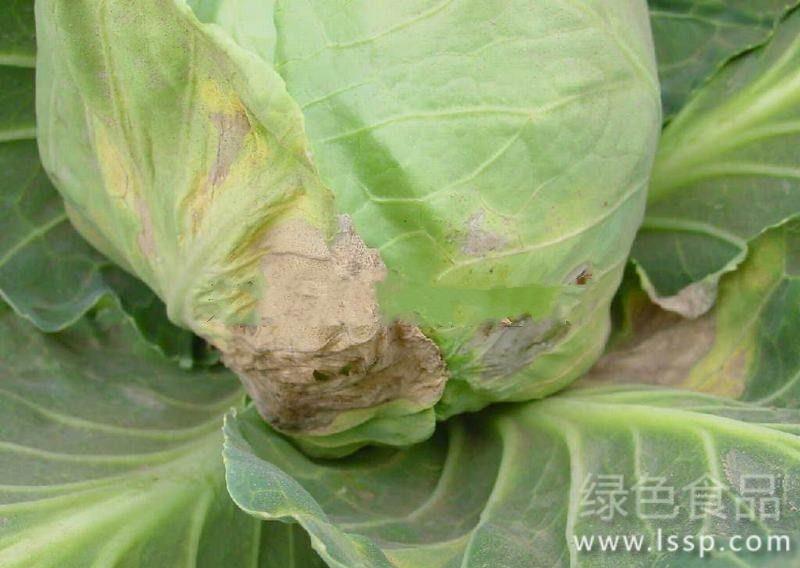
Cabbage black rot
Symptom identification:Black rot mainly harms cabbage leaves, leaf heads or stems. When the disease occurs at the seedling stage, the cotyledons become water-soaked and rapidly wither and die or the damage extends to the true leaves. In the early stage of the disease, yellow-brown “V”-shaped spots first appear at the leaf margin at the tip of the veins, gradually expanding to the entire leaf margin and forming a yellow-brown band. If the disease occurs when there are 5 to 10 true leaves, the lowest leaves of the cabbage begin to wilt and turn yellow, and then the entire cabbage gradually withers; if it occurs at the rosette stage, there are black spots on the curd, the head is soft and not solid, and it is completely worthless. Once cabbage black rot occurs, the infected area is relatively large and the disease develops quickly, causing reduced yield.
Occurrence pattern:The black rot pathogen overwinters on cabbage seeds or with diseased residues in the soil. It invades from the leaf margins of cabbage seedling cotyledons or true leaves through water pores or wounds, and quickly enters the vascular bundles, causing disease at the leaf base. The pathogen can spread through farm tools and rainwater. High temperature and high humidity, continuous cropping on the same land, poor soil drainage, large nitrogen fertilizer application, low application of organic fertilizer, potassium fertilizer, and trace elements such as zinc, manganese, and molybdenum, and an imbalanced soil microbial environment all favor the survival and reproduction of cabbage black rot and its pathogen.
Prevention and control methods:(1) Agricultural control. Soak cabbage seeds in warm water at 50°C for 20 to 30 minutes, or soak them in 0.1% copper sulfate solution for 15 minutes. Implement a 2 to 3 year rotation with cruciferous vegetables on plots where black rot occurs severely. Improve soil supply and drainage conditions, and increase the application of organic fertilizer, phosphorus and potassium fertilizer, and micronutrient fertilizer. (2) Chemical control. For seedbed disinfection, use 50% amobam 800 to 1000 times solution to wet the soil, or use 50% carbendazim 800 times solution to irrigate the cabbage seedbed. In the early stage of the disease, use 14% copper-ammonia complex aqueous solution 600 times, or 77% copper hydroxide wettable powder 500 times, or 72% agricultural streptomycin soluble powder 5000 times, once every 7 to 10 days, spraying 2 to 3 times continuously.