How to prevent and control zucchini powdery mildew that causes leaves to turn brown and die
Zucchini powdery mildew mainly affects the leaves, followed by the petioles and stems, while the fruit is less commonly affected. In the early stage of leaf infection, small round white powdery spots appear, which gradually expand into irregular white powdery mildew patches (the powdery mildew fungus's conidia). The lesions can merge into larger patches, and the affected parts of the leaves gradually turn yellow. In the later stage, many yellowish-brown small granules (the fungus's cleistothecia) form on the lesions. In severe cases, the diseased leaves turn brown and die.
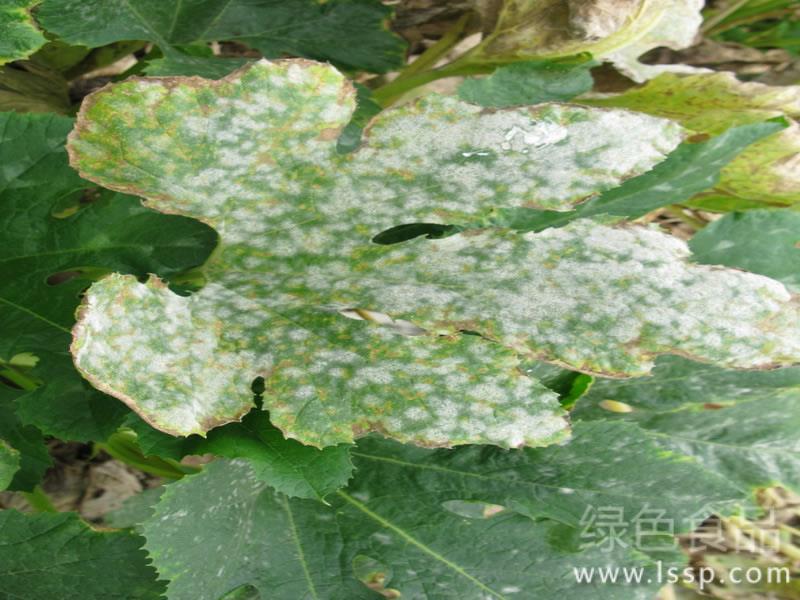
Zucchini powdery mildew
Causes of the disease: The powdery mildew pathogen overwinters as cleistothecia in the soil together with zucchini plant debris, or overwinters while causing damage inside protected cultivation areas. In southern vegetable-growing areas, the pathogen overwinters and oversummers on host plants as mycelium or conidia. It spreads through airflow, rainwater and irrigation water. The disease can occur at 10-25°C, and when high temperature and dryness alternate with humidity, the disease develops rapidly. In the later growth stage, zucchini plants grow weakly and the disease becomes severe. Excessive planting density and nutrient deficiency during the growing period also lead to more severe disease.
Integrated control techniques:
(1) Clean the field and remove residual plants. Diseased plants' old leaves and diseased leaves should be removed as early as possible, and diseased plants should be removed from the field or burned.
(2) Strengthen field management. Ensure reasonable ventilation and light penetration, and proper fertilization and watering. Prevent excessive vegetative growth and premature senescence, and keep plants growing vigorously.
(3) Biological agent control. Spray with Nongkang 120 diluted with water in the early stage of disease onset, once every 7 days, for 2-3 consecutive sprays.
(4) Smoke agent control. In the early stage of disease onset, in protected cultivation areas, 45% chlorothalonil smoke agent (safety type) can be used at 110 g-180 g per mu, divided into 4-5 spots, ignited with the greenhouse closed for fumigation overnight, generally once every 7 days, for 3-4 consecutive fumigations.
(5) Spray control. In the early stage of disease onset, use 25% triadimefon wettable powder at 2500-3000 times dilution, or 30% triflumizole wettable powder at 2000-2500 times dilution, or 25% triadimefon emulsifiable concentrate at 2000 times dilution, or 10% difenoconazole water-dispersible granules at 2000-2500 times dilution, or 40% sulfur-carbendazim suspension concentrate at 600 times dilution to spray zucchini leaves in the early stage of disease onset, once every 7-14 days, for 3-4 consecutive sprays.