Tomato late blight harms the whole plant: how to prevent and control it
Late blight occurs on leaves, stems, fruits and foliage. The lesions mostly start first from the leaf tip or leaf edge of the tomato, initially as water-soaked chlorotic spots, then gradually expand. When humidity is high, the lesions expand rapidly and can spread over more than half of the leaf or even the entire leaf, and can invade along the leaf veins into the petiole and stem, forming brown streaks. Finally, a ring of white mold grows along the edge of the plant's leaves, most obvious on the underside of the leaves after rain or on dewy mornings, and when humidity is especially high it can also appear on the upper surface of the leaves. In dry weather the lesions dry up and turn brown, with no white mold on the underside of the leaves, and they are brittle and crack easily, spreading slowly. On the stem cortex, brown streaks of varying length form, and in humid conditions the lesions also produce sparse white frost-like mold.
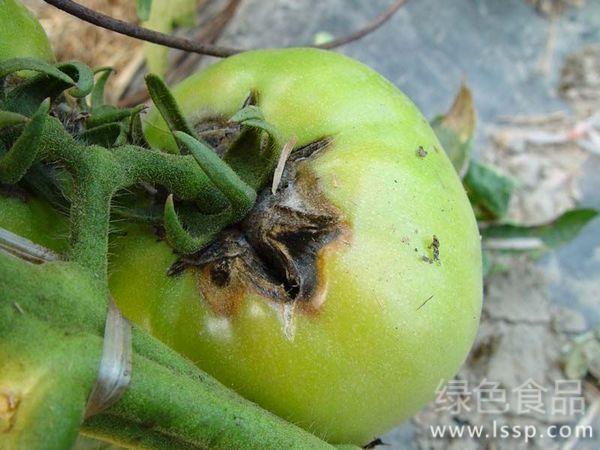
Tomato late blight
Causes of the disease: the occurrence and epidemic of late blight are closely related to climatic conditions, and the speed of development is also closely related to the cultivation conditions of the tomato and the disease resistance of the plant itself. (1) Climatic conditions: at an air temperature of 25°C the incubation period is shortest, only 3 to 4 days; excessively high temperatures are instead unfavorable to the epidemic of the disease. The pathogen has strict requirements for relative humidity, and it can occur only at 75% or above. (2) Cultivation conditions: lush plants, low-lying terrain, poor drainage, and excessive field humidity favor the occurrence of the disease; poor soil with weak plants, or excessive application of nitrogen fertilizer causing excessive vegetative growth, as well as tomatoes being in the middle and late stages of growth, all favor the occurrence of the disease. (3) Varieties: tomato varieties with strong disease resistance are less prone to the disease, such as Zhongshu No. 4.
Integrated control techniques: (1) Choose disease-resistant varieties such as Baili, Zhongshu No. 4, Zhongshu No. 5, Jiafen No. 15, Jiafen No. 17 and other varieties. (2) Choose plots with high, dry terrain and convenient drainage and irrigation for planting, and plant at a reasonable density. Apply nitrogen fertilizer reasonably and increase potassium fertilizer. Never flood-irrigate, and drain promptly after rain. Strengthen ventilation and light penetration; in protected cultivation, ventilate promptly to avoid dew or a water film forming on the leaf surface of the plants, so as to reduce the severity of the disease. (3) Cultivate disease-free strong seedlings: the pathogen mainly overwinters in the soil or in diseased plant residues, so the seedling soil must be strictly selected from soil that has never grown solanaceous crops; the use of nutrient pots, nutrient bags, plug trays, etc. to cultivate disease-free strong seedlings is advocated. (4) Clean up the field: after harvesting crops such as tomato, cucumber, pepper and celery, thoroughly remove diseased plants and diseased fruits to reduce the primary infection source. Frequently check the leaves on the lower part of the tomato plants near the ground; once a central diseased plant is found, immediately remove the diseased leaves, diseased branches, diseased fruits or the entire diseased plant, and bury it deeply or burn it in a place far from the field, while immediately applying a fungicidal pesticide and disinfecting continuously to prevent the disease from spreading. (5) You can use 75% chlorothalonil wettable powder at 700 times dilution, or 25% metalaxyl wettable powder at 600 times dilution, or 70% mancozeb wettable powder at 500 times dilution, spraying once every 5 to 7 days, for 2 to 3 consecutive sprays.