High-yield cultivation techniques for brewing sorghum, growing mellow and great-tasting grain
I. Site selection
Choose loam or sandy loam plots with fertile soil, deep soil layers, uniform soil fertility, flat terrain, convenient irrigation and drainage, far from pollution, and slightly acidic to weakly alkaline for planting sorghum, to lay a good foundation for achieving high and stable yields.
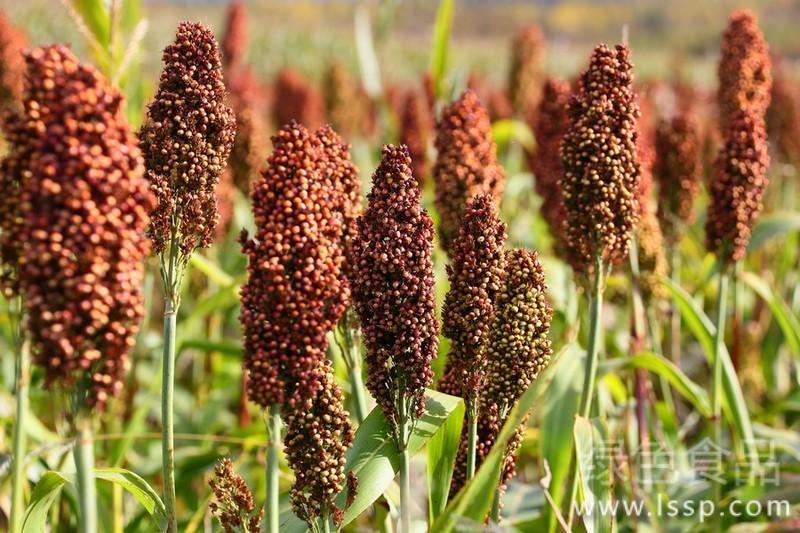
Sorghum
II. Seed selection and sowing
Choose improved brewing sorghum varieties that have passed national (or provincial or municipal) approval and are suitable for local cultivation, with characteristics such as high quality, high yield and multiple resistance. Select good seeds that are plump and uniform, undamaged and disease-free, with purity ≥99%, cleanliness ≥97%, germination rate ≥95% and moisture content ≤13%, and sun-dry them for 2 to 3 days to improve their germination vigor and germination rate. Sowing can begin when the soil temperature within the 8 cm plough layer is ≥12°C for 5 consecutive days and the soil moisture content is about 18%. The best sowing period is mid-June; mechanical drilling in rows on ridges should be adopted, with a sowing rate of 0.5 to 0.8 kg per mu, uniform sowing depth, and a soil cover thickness after compaction of preferably 2 cm.
III. Weeding
Use a combination of chemical weeding and manual weeding to remove all kinds of weeds. Chemical herbicides may be selected that are suitable for use before sowing, before emergence or after emergence of sorghum and that have no toxic effect on the following crop. After thinning and before the plants close the rows, complete 3 manual weedings; in the later growth period, cut or pull out large weeds in the field and around it, to reduce the number and harm of weeds the following year.
IV. Fertilization
In brewing sorghum cultivation, adhere to the fertilization principles of formula fertilization, balanced fertilization, staged fertilization, fertilization according to need, and the combination of farmyard manure, chemical fertilizer and micro-fertilizers, as well as the combination of base fertilizer, seed fertilizer and topdressing. The specific number of applications, timing, types, amounts and methods should all be flexibly controlled according to the seedlings, time, weather and local conditions. Usually, during land preparation, apply 4000 to 5000 kg per mu of fully decomposed high-quality farmyard manure, 15 to 20 kg of ternary compound fertilizer (15-15-15) and an appropriate amount of micro-fertilizers such as zinc, iron and selenium as base fertilizer; at sowing, apply 8 to 10 kg of diammonium phosphate as seed fertilizer (seeds above, fertilizer below, with the seeds and fertilizer separated by 6 to 8 cm); and before rain at the jointing stage, topdress with 20 to 25 kg of urea as ear (grain) fertilizer.
V. Pest and disease control
In brewing sorghum cultivation, implement the plant protection policy of “prevention first, integrated control”, achieving early prevention, early detection and early control. During the growth period, be sure to select broad-spectrum, high-efficiency, low-toxicity, low-residue, safe for humans and livestock, pollution-free pesticides or biological pesticides to promptly control leaf spot, smut, armyworm, aphids, stem borers and other pests and diseases. The same pesticide must not be used more than two times in succession, to avoid developing resistance. For various diseases, control should be carried out at the early stage of sorghum infection or before the disease has spread; for various pests, control should be carried out during their egg-laying period or larval hatching period. This can not only achieve twice the result with half the effort, but also reduce the number of pesticide applications, reduce the amount of pesticide used, prevent environmental pollution, and achieve energy conservation and environmental protection while lowering production costs.