How to prevent and control grape root rot that causes root death
Grape root rot first develops on the fibrous roots, forming reddish-brown round spots. The spots merge and expand, penetrating deep into the xylem. The xylem first turns reddish-brown, then brown, and finally dark brown, until it dies.
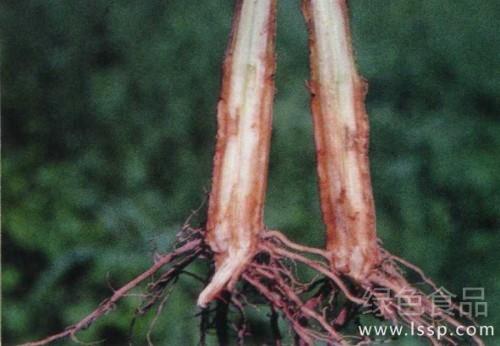
Grape root rot
Above-ground symptoms: During the grape growing season, the following are observed: (1) Wilt type. Leaf clusters wilt, leaves curl upward and become deformed, leaves are small and pale, new shoots are difficult to push out, flower buds shrivel without opening or the fruit set rate is extremely low, branches lose water, shrivel or die. This type mostly occurs on plants over 4 years old. (2) Sudden drying type. In diseased plants whose roots are infected and the disease progresses rapidly, during spring drought and higher temperatures, the leaves suddenly lose water and dry out green, mostly spreading inward from the leaf margins or extending inward from the main vein, with an obvious red halo band between the diseased and healthy parts. In severe cases, leaves fall off. This symptom mostly occurs on young parts. (3) Leaf margin scorch type. When spring is not dry, the disease progresses slowly. When it occurs, leaf tips and margins scorch, but leaves generally do not fall. (4) Branch dieback type. Root rot corresponds to the death of large branches, the cortex turns brown and sinks, the boundary between good bark and bad bark is distinct, and in the later stage the necrotic cortex peels off and the xylem vessels turn brown.
Pathogens and infection. Garden spot root rot is mainly caused by Fusarium solani, Fusarium oxysporum, and Fusarium camptoceras. They are all soil-inhabiting fungi that live saprophytically in the soil. Only when the tree body weakens does the tree become diseased. The pathogens can spread in the soil through water flow. Underground pests, pathogen-carrying soil, and gardening tools can all carry and spread the disease. The pathogens mostly invade through wounds, and under suitable conditions, infection can be completed in 3 days. After infection, healthy grapevines do not develop the disease but instead remain latent. Only when the tree vigor weakens or the infection reaches a certain level do symptoms appear. Generally, infection occurs in the first year, and symptoms appear after 2-3 years.
Prevention and control measures
1. Reasonable vineyard establishment. Avoid establishing a vineyard on continuous cropping land. If a vineyard must be established there, soil disinfection and soil improvement must be carried out, such as spraying the ground with 100 times sodium pentachlorophenate; broadcasting plant ash on the ground to change soil pH and destroy the living environment of pathogens; broadcasting ferrous sulfate on the ground, etc.
Avoid establishing a vineyard in low-lying, waterlogged, and wet land. If the groundwater level is above 1 m, high-ridge planting or digging drainage ditches should be adopted to prevent the water level from rising. Before planting, dig planting trenches with a depth of 1 m each according to the row spacing, and apply more than 5000 kg of organic fertilizer per mu.
2. Use virus-free seedlings for vineyard establishment. Try to use grafted virus-free seedlings for vineyard establishment. Better rootstocks for grafting are Beta and Kyoho.
3. Improve cultivation conditions, implement sod culture, water timely and drain promptly, prevent soil erosion, maintain reasonable crop load on the vine, and avoid alternate bearing. Strengthen the prevention and control of above-ground pests and diseases.
4. Chemical control. Before bud break and when symptoms first appear, use 200-500 times copper sulfate or 1 degree Baume lime sulfur mixture or 200 times agricultural antibiotic 120 water solution or 200 times Shuangxiaoling or 300 times Duoxiaoling for root irrigation. When irrigating roots, use 10-15 kg per grapevine. After diseased trees are found in early spring, apply meifuke to the soil, spreading 100 g per tree under the tree disk, deeply hoe the soil, mix it evenly with the soil, and then water. After diseased trees are found during the growing season, immediately dig out the root system and apply 10 times junduqing solution, or 3 degrees Baume lime sulfur mixture, or 2% 402 fungicide, etc. to the wounds.
Before bud break, remove soil from around the roots of grape plants found infected in the previous year and expose the roots to the air, that is, expose the root crown and stem, and after sunning for 7-10 days, use 30-50 times formasan to disinfect the wounds. At the same time, disinfect the ground with 100 times sodium pentachlorophenate, and after applying fermented and decomposed cake fertilizer or chicken manure, cover with soil and water.